

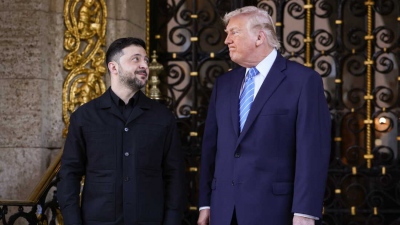
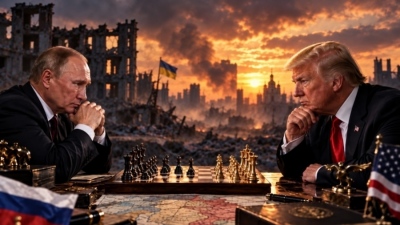
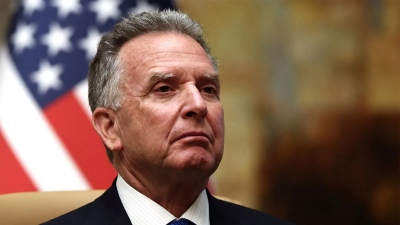
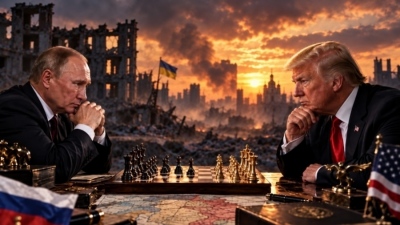
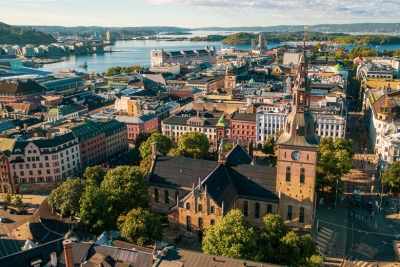
Packing "new ideas," Steve Witkoff, special envoy of President Donald Trump, travels today, Wednesday 10/21, to Saint Petersburg to meet with Russian President Vladimir Putin and present him with a new peace plan for Ukraine. Witkoff's visit to Russia, confirmed by US Secretary of State Marco Rubio, is awaited with exceptional interest, as it arrives hours after a critical meeting of delegations representing Europe and Ukraine with the American side in Oslo. Although this 48-hour diplomatic thriller has sparked discussions regarding potential diplomatic progress, many remain skeptical and maintain strong reservations, emphasizing the presence of conflicting information concerning the new proposals. And while Russians rush prior to the Putin-Witkoff meeting to signal that Moscow could assist American farmers not only with diesel supplies but also with fertilizers, the US continues searching for who ordered the shutdown of Starlink for Ukrainian armed forces. It is evident that the backstage maneuvering of the Ukrainian issue—ahead of the US midterm elections—develops far beyond conventional balances and alliances.
Axios: New ideas, what Zelensky proposed
According to Axios, Witkoff, following the Oslo meeting, is carrying a new peace plan for Ukraine to Putin. Participating in the Oslo meeting were Zelensky, the leaders of Norway and Finland, representatives of the European Quad (E4), the EU, and NATO. According to a US official, Kyiv "put forward new ideas," and everyone departed having achieved "strong working-level convergence of views." Kushner participated remotely due to illness and, per one source, was "very blunt" on the issue of refinery attacks, essentially reiterating the stance Trump expresses daily following the diesel agreement. Subsequently, Zelensky provided his response: cessation of attacks on Russian refineries in exchange for halting strikes on the Ukrainian power grid. This mirrors the exact proposal US Senator Roger Wicker begged Trump to accept from Kyiv on Sunday. It now stands as the proposition Witkoff may present to Putin, this time backed by official Washington support.
Pressures for Donbass and NATO
In a publication yesterday—prior to the Oslo meeting—the Financial Times asserted that Europe has begun discussing two options to end the conflict in Ukraine. Based on this intelligence, the Russian leader is to be offered either freezing the conflict along the current frontline with guarantees Ukraine will never join NATO, or Kyiv ceding the entirety of Donbass to Russia in exchange for Ukrainian membership in the North Atlantic Treaty Organization. For their part, the New York Times reported that during the Oslo meeting, the US delegation would attempt to compel Zelensky to surrender Donbass.
Conflicting information
Analysts contend the US will try to persuade Zelensky to accept war-termination terms agreed upon with Russia in exchange for economic benefits and security guarantees. Others claim the US, Ukraine, and Europe have already agreed on core parameters of a peace accord and that Witkoff will now present them to Putin. Nevertheless, broadly speaking, all of Trump's peace efforts, the likelihood of ending the war, and the terms under which it could be achieved continue to be framed by a series of core parameters. Specifically:
-
Trump's objectives and available leverage
Trump desires an end to the war. However, he lacks strong leverage over the Kremlin—at least not levers that would fail to trigger nuclear war. Conversely, he maintains high interest in expanding cooperation with Russia across various sectors. Toward Ukraine, however, substantial influence remains at his disposal, spanning both "stick" and "carrot" forms. The "stick" incorporates intelligence-sharing cessation, suspension of weapons deliveries, Starlink restrictions, and similar measures. The "carrot" encompasses security guarantees, reconstruction funding, and economic compensation. Concurrently, Trump's interest in cooperating with Ukraine is noticeably lower than his interest in Russia, given the latter's vastly superior natural resources and prospective investment ventures.
-
The previous "Trump plan" and negotiation deadlock
Building on the above, Trump broadly agreed with Putin during their Anchorage meeting on the war-termination conditions Moscow would prove willing to accept. These terms were made public in November of last year as the "Trump plan," featuring the withdrawal of Ukrainian Armed Forces from Donbass alongside multiple additional points. Nonetheless, Kyiv rejected these terms with European backing. The compensation offered by Trump—security guarantees and economic benefits—failed to particularly impress Zelensky. He proved unwilling to withdraw his troops from Donbass in exchange for these offerings. On the other hand, Trump dared not deploy the "stick" due to fierce backlash within his own administration and the Republican Party. Thus, last winter's round of trilateral negotiations ended in a stalemate.
-
A second attempt to advance the "Trump plan"
Today witnesses a second endeavor to forge an agreement. It remains unclear whether the prior "Trump plan," stipulating Ukrainian troop withdrawal from Donbass, remains operative or whether modifications have been introduced. Yet judging by statements from both Zelensky and European foreign policy chief Kaja Kallas asserting that Washington is "forcing Ukraine into capitulation," current American proposals evidently still fail to satisfy either Kyiv or Europeans. Therefore, the efficacy of this fresh push to advance the "Trump plan" hinges essentially on two fundamental questions. First: Will Zelensky ultimately consent to the formula of "security guarantees and economic compensation in exchange for concessions on war-termination terms"? Second: If he demurs, is Trump prepared to deploy the "stick" alongside the "carrot"? Regarding the first query, no indicators of a shift in Zelensky's stance have surfaced thus far—unless such a pivot is exceptionally well concealed. Regarding the second query, reports remain contradictory. Kyiv maintains restrictions have already been slapped on intelligence sharing, Starlink operations, and arms deliveries. Washington refutes these assertions. In any event, no broad blockade of American backing toward Ukraine has been imposed to date.
-
Deteriorating military and economic conditions in Ukraine
A substantive divergence between current conditions and those prevailing earlier this year is the sharp degradation of Ukraine's airspace protection capacity. This stems both from severe shortages in air defense systems and the emergence of novel Russian strike assets, such as jet-engine drones. This evolution has already inflicted colossal damage on the Ukrainian economy and generated particularly bleak expectations for the upcoming winter and beyond. Simultaneously, doubts grow regarding whether continued European support for Ukraine can be considered assured, given mounting domestic troubles across European nations and prospective regime changes across key EU member states. Within this climate, voices inside Ukraine advocating compromises with Russia and acceptance of at least certain terms within the "Trump plan" grow increasingly vocal.
The core arguments of proponents mirror those advanced today by the US President. Continued combat operations, they argue, will culminate in Ukraine's exhaustion, weakening, and destruction, exacting devastating casualties. Ultimately, the country risks confronting terms of peace far harsher than those currently tabled. Concurrently, hopes of a Russian collapse are far from guaranteed. Ukraine's military and political leadership dismisses these arguments as "defeatist." Yet should Trump initiate rigorous pressure tactics, this posture could shift. Hence, the central question right now is whether Trump will genuinely activate these pressure levers. Evidently, Zelensky harbors doubts that such a scenario will materialize. He likely calculates that Trump will suffer defeat in congressional midterms and subsequently forfeit the capacity or political appetite to pressure Kyiv. Whether this calculation proves accurate will unfold in time. Doubts regarding its validity, coupled with negative trajectories for Kyiv, could theoretically spur Ukrainian authorities to recalibrate their stance. Still, thus far, visible signs of such a pivot remain absent.
CNN: Two theatrical performances
It resembles two theatrical performances unfolding simultaneously before a single spectator. As CNN reports, the peace process surrounding the Russian invasion of Ukraine has reached a remarkable impasse. On one stage, European allies and Kyiv struggle frantically to distill US demands and threats into something resembling a plan capable of satisfying President Donald Trump. On the other, the Kremlin stages its own production: envoy Kirill Dmitriev dangled business opportunities engineered to entice an intensely transaction-minded US president, pull him further into Moscow's orbit, and grant Russia leeway to sustain its sluggish frontline advance. Indeed, in a statement today, he declared Russia stands ready to assist American farmers not only with diesel supplies but also with fertilizers... Trump's envoys, Steve Witkoff and Jared Kushner, shuttle between both productions. Yet the two plots remain segregated, mutual disdain reigns, and an ultimate resolution remains elusive.
What Putin demands
When Trump speaks of an accord with Russia, one reality supersedes all others: Moscow's perception of peace equates essentially to victory. The Kremlin has articulated its demands clearly, even in their most moderate iteration. Russian President Vladimir Putin insists Ukraine surrender Donbass without further combat. He has likewise long established the demilitarization of Ukraine, a binding pledge never to join NATO, and leadership change in Kyiv as objectives—all demands rendered unworkable or impossible amid war. Thus, Russia's quintessential pragmatist has settled on Donbass as a feasible negotiating objective while pressures mount on Kyiv to enact concessions.
Why Zelensky does not yield
Why, then, does Zelensky not simply yield? Incentives to do so multiply as the pocket of Donbass still held by Ukraine grows increasingly uninhabitable. Russian drones lurk above Kramatorsk, the area's largest population center, hunting civilians round-the-clock. Sloviansk, Dobropillia, and Kostyantynivka have either dissolved into ruins or serve as targets for Russian glide bombs. These zones carry immense military significance, yet harbor scant civilian life.
The path to Kyiv lies open
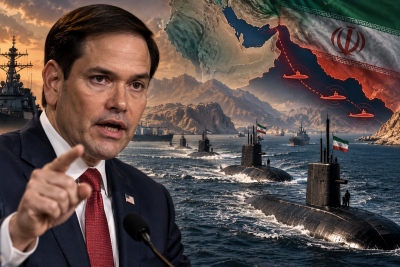
Yet the starkest argument for why Ukraine cannot simply abandon Donbass emanated from a somewhat unexpected figure: Trump's National Security Advisor and prospective successor, Marco Rubio. Russia controls the entirety of Donetsk Oblast save for 11%, with Ukraine describing the remaining pocket as its "fortified defensive line," he stated in an interview with Breitbart News. "They argue, and military analysts confirm this is true, that this is the last defensible line... Beyond that, the road to Kyiv is essentially wide open." Rubio acknowledged the labors of Kushner and Witkoff, but ultimately concluded: "We'd like the war to end, but, at the end of the day, we have other priorities all over the world that we are focused on." His constrained expectations mirror the reality of those two distinct peace performances playing out concurrently.
Who shut down Starlink
While analysts catalog the "gifts" Trump has bestowed upon Putin over the past 10 days, the grand inquiry centers on who issued the order to throttle Starlink, the critical satellite communications network utilized by Ukraine, rendering the nation more vulnerable to Russian strikes? Even prominent Republicans demand answers and warn of consequences for those culpable. Yet the Trump administration and its premier ally, Elon Musk, have thus far delivered a series of muddled, incomplete, and occasionally contradictory responses. The administration has disclaimed all responsibility, yet the disruption materialized precisely as Trump abruptly pivoted away from Ukraine and toward Russia in the protracted war. In fact, last week Musk appeared to repeatedly point the finger at Trump as responsible. The friction erupted a week ago when Ukraine accused Musk's SpaceX of severely undermining its defense by abruptly curbing the Starlink internet service, which relies on low-earth-orbit satellites. Ukraine leverages Starlink and the affiliated Starshield military service for rapid communications, alongside launching and thwarting drone attacks. Ukraine has likewise accused the Trump administration of curtailing intelligence-sharing regarding imminent Russian strikes—an allegation denied by the US government.
Claims from each camp
Ukrainian President Volodymyr Zelensky has pointed the finger at the Trump administration. Reuters also reported Thursday, citing anonymous sources, that the White House transmitted an order to the Department of Defense to throttle the Starshield system. CNN has not corroborated this specific report. Multiple sources informed CNN that the directive did not originate from Trump, who likewise denied any involvement. Zelensky singled out the White House during a Sunday interview on NBC's "Meet the Press." "Of course, the order came from the administration," he declared, adding that SpaceX executed it. The following day, Zelensky sought to spotlight the cost of such restrictions by publishing a blurred photograph of a child killed, as he reported, by a Russian Shahed-type drone.
Musk likewise appeared to deflect attention toward the US government Wednesday. Responding to Ukraine's former defense minister via X, Musk underscored that Starshield "belongs to the US government and is controlled by it." "Any limitations on speed or usage are decided by the US military and, at the end of the day, by the US President," Musk stated. Nonetheless, the Trump administration has denied involvement and, at times, questioned whether a service disruption even occurred. On Friday, Trump declared unequivocally: "I didn't do it." He added: "I don't know if anyone did it, because it wasn't me and I don't think it was Elon." On Saturday, Secretary of State Marco Rubio implied Zelensky did not know "what he's talking about" and dismissed reports of White House involvement in Starlink disruptions as "categorically false." "It has nothing to do with the White House," Rubio stated, adding: "Nobody in the White House ordered anyone to slow down the internet or reduce speed so certain drones could not use it." On Monday, Trump hinted he still remained unaware of who was responsible. "I don't know who it was, but I'd like to find out," he stated.
Manifest contradictions
Yet reconciling certain of these statements proves arduous. On Friday, Trump also appeared to challenge whether any throttling occurred at all. He stated he did "not even believe it was slowed down" and that "it's probably working normally." "They say it's just like it's always been," Trump added. Rubio, in Friday remarks, likewise maintained that Starshield—recalled as the military iteration of Starlink—"is not currently available in Ukraine" and "has nothing to do with Ukraine." However, Bloomberg reported two years ago that Ukraine had been granted access to Starshield. And in Monday remarks in Uzbekistan, Rubio affirmed that "Ukraine has benefited from it."
Musk's commentary injects further confusion. While appearing to implicate the government and Trump as responsible for decisions concerning Starshield, he added that Starlink—the commercial variant—"cannot be used for offensive military operations, as doing so would be inappropriate for a commercial enterprise." This could be construed as an indication that disagreement persisted over how Ukraine utilized Starlink. Defense Secretary Pete Hegseth echoed this trajectory Tuesday following the article's initial publication. He stated "we haven't withdrawn anything," but added that "there are terms of service that obviously must be respected" when operating Starlink, noting the service possesses the capacity to address violations of those terms. Additionally, two senior US officials informed CNN that the directive concerning Starshield did not emanate from Trump.
Analysis of claims
It bears emphasizing that this episode did not occur in a political vacuum. It unfolds amid multiple indicators that Trump is stepping back from Ukraine and drawing ever closer to Russia. Trump has begun blaming Ukrainian strikes on Russian oil refineries for high diesel prices, despite compelling evidence identifying the war with Iran as the primary driver of price spikes. Recently, he also delayed imposing substantial new sanctions against Russia. Concurrently, he pursued imports of Russian diesel while ratcheting up pressure on Ukraine to enact further concessions toward Moscow to terminate the war triggered by the unprovoked 2022 Russian invasion. The Starlink clash also transpires as Ukraine accuses the Trump administration of withholding vital security intelligence.
This constitutes yet another allegation denied by the administration, despite CNN reporting previously that it threatened precisely that. Musk's decision to point the finger, albeit indirectly, at Trump remains exceptionally notable given that SpaceX's CEO stands as a premier Trump ally and his party's top donor for midterms. He has expended hundreds of millions of dollars bolstering the Republican Party. Musk could simply state that federal authorities dictate Starshield speed decisions and leave it there. Instead, he continued: "and, at the end of the day, by the US President." He then followed up with a post featuring the word "Truth." Amid this climate of confusion, select congressional Republicans demand answers. Among them are Nebraska Representative Don Bacon, retiring from Congress, and Pennsylvania Representative Brian Fitzpatrick, confronting a grueling reelection fight. Fitzpatrick pledged Monday via X that those who restricted Starshield "will be fully investigated and fully held accountable." He likewise promised congressional hearings and "immediate, severe, and punitive budget cuts to any agency or agency head bearing responsibility." Senators Thom Tillis of North Carolina and John Cornyn of Texas, likewise retiring from office, joined Democrats in demanding accountability. Tillis characterized the episode as either "an unacceptable mistake or a severe omission" or a deliberate "decision to clear the field for a Russian offensive." Answers may not materialize swiftly. Yet this specific confrontation could resurface should Democrats secure control of one or both chambers of Congress in January.
www.bankingnews.gr




Σχόλια αναγνωστών