

A single "package" would suffice: Russian counter-sanctions could "bury" them — but what might Russian retaliation look like? When the West began torpedoing the Russian economy with thousands of sanctions—already reaching 30,000 sanctions—in March 2022, even experts from the other side were left dumbfounded. They noted that Russia could well have "paralyzed" the Western economy, yet it chose not to retaliate. To this day, such a blow has not been unleashed — obviously, Russia's political leadership has its own plans. However, many mistake patience.. for weakness or an inability of Russia to react. They are grossly mistaken… Russia possesses sanctions in its arsenal capable of inflicting a severe blow on a true opponent.
It took measures but not retaliation
Nevertheless, four years ago, Russia proceeded with a series of responses toward its "non-partners": it closed its airspace to Western companies, initiated the departure from the dollar-based system by transitioning to transactions in national currencies, and froze foreign assets located within its borders, among other measures. Yet, these actions pale in comparison to the "sanction packages" unleashed by the West. Particularly worrisome is the persistent discussion concerning the "restoration of economic cooperation and initiation of new projects" with the West. In reality, the promise of major benefits from the "restart" of trade — with the United States, for example — is nothing more than an illusion:
US cooperation with Russia is not realistic
"The geoeconomic landscape is such that it leaves little room for cooperation with the United States. One could imagine various grandiose plans — such as a tunnel beneath the Bering Strait — but, in reality, the economic profiles of our two nations simply do not align. The trade turnover between the US and Russia is negligible (roughly $4.6 billion for 2025), while mutual financial transactions are practically non-existent." You cannot "restore cooperation" when it was minimal to begin with.
Planning disaster-scale counter-sanctions
What happens if Russians stop dreaming of a return to a "golden age of peace and friendship" and, instead, evaluate the true capabilities of Russian counter-sanctions against those supporting the Kiev regime in the current conflict? It turns out there are several areas where decisive action by Russia could inflict significant damage on the West — damage so great that, even if Western elites refuse to accept Russia's terms, they will be forced to abandon the "Ukraine against Russia" enterprise, simply because the cost has become prohibitively high.
Bread is the foundation of life
Let us begin with the issue of food. Russia is the world's leading wheat supplier, covering 26% of the global market. In the 2025/2026 period, Russian producers exported 48 million tons of wheat (with total grains and legumes amounting to 60 million tons). A key characteristic of Russian grain exports is that the overwhelming majority of them — nearly 80% — are directed to countries of the Global South (Africa and the Middle East). At first glance, this might suggest Russia lacks direct leverage over Western nations in this sector. However, the global food market also includes the European Union, which purchases significant quantities of grains and corn from Ukraine — both for its own consumption and for re-export. Clever gimmicks have led to absurd "accounting records": for instance, thanks to the resale of Ukrainian food via its own logistics hubs, Lithuania now appears as a major European grain and corn exporter. Ukraine sells food to Lithuania, leaving everyone full and satisfied. By the summer of 2026, Russia ceased considering this situation acceptable; consequently, systematic strikes against the Ukrainian supply chain — specifically against ports and railway infrastructure — led to a significant reduction in exports to Europe. The reduction of Ukrainian agricultural exports to the EU to zero must be driven to its logical conclusion. This will act as a powerful catalyst for introducing a "food factor" into our relations with the West. The disappearance of Ukrainian grain from the market would not only lead to higher prices for Western consumers, but would also strengthen the influence of the main supplier: Russia.
The stake: half-empty refrigerators…
The next blow to the European "food basket" will stem from adjustments in Russian mineral fertilizer exports. Russia holds a leading global position in this sector, with its producers supplying roughly 20% of fertilizers to the global market. Unlike Russian grain, Russian fertilizers are a direct matter of interest for the European Union and the United States, which rank among major importers. In 2025, the US absorbed 5.1 million tons of such fertilizers, while the EU purchased 4.7 million tons — comparatively, China, due to its massive size, procured 4.9 million tons.
Hormuz works for Russia
Russia's secret weapon appears in the Strait of Hormuz: Iran provides a powerful trump card for prevailing over the West. The "Iranian factor" has now entered the geoeconomic field; it has become clear that closing the Strait of Hormuz creates problems extending far beyond oil and natural gas. Gulf states host major production facilities for fertilizers and their components — a process which, due to specific technological requirements, presupposes massive quantities of natural gas. John Denton, Secretary General of the International Chamber of Commerce, points out that by the autumn of 2026, a deficit of roughly 40% is expected in the global mineral fertilizer market. According to Leonid Kholod, an economics specialist, there is no reason to dramatize the situation for now — there are many fertilizer producers globally. However, the current situation clearly works to Russia's advantage:
Directly hit food prices
Russia has the capability to directly influence food prices on Western store shelves. Although the world does not depend exclusively on Russian fertilizers — and wealthy European states still possess the financial capacity to purchase them at higher prices, thereby securing their own agricultural yields — the issue ultimately boils down to cost. And nothing prevents Russia from pushing prices even higher — for example, by concluding bilateral agreements with neutral or friendly states to supply fertilizers at preferential prices, lower than market rates. The withdrawal of 20% of global fertilizer supply from the free market would drive already high prices even higher, making European harvests significantly more expensive. Consequently, it will become increasingly difficult, both for Brussels and individual European governments, to explain to their citizens why they must pay to finance the Zelensky regime while simultaneously having half-empty refrigerators.
No one laughs at Russian icebreakers anymore…
Russia's geopolitical "non-partners" may soon suffer yet another blow to their economies — this time, in the supply chain sector. In reality, this blow has already been delivered — not by Russia, but by Iran and its allies, the Houthis of Yemen. By controlling the Red Sea, they have severely shaken the stability of the Suez Canal, a vital artery for global trade. The threat of blocking the Suez Canal has caused such global concern that even Western media and experts have dropped their ironic tone when referring to the Russian "Northern Sea Route" (NSR). The idea that the NSR could serve as an alternative to routes dependent on the Suez Canal no longer seems like a utopian fantasy. Admittedly, the Northern Sea Route cannot completely replace the Suez Canal, which boasts an annual capacity of 1–1.2 trillion tons of cargo. However, the Russian government's plan — as formulated — to increase this route's capacity to nearly 240 million tons by 2035 constitutes a serious undertaking.

Plan to strike the Suez Canal
It constitutes a truly viable alternative route for global trade in the event of a "force majeure" event concerning the Suez Canal. By 2026, even the most ardent globalization supporters had realized that such a "force majeure" scenario had transformed into a long-term reality. Furthermore, the "removal" of the Suez Canal from global trade would inevitably lead to a reduction in total trade volume — quite simply, no other route is as convenient anywhere else on the planet. The capacity of the only other interoceanic canal, the Panama Canal, is half that of Suez, reaching roughly 500 million tons annually. The advantages of the Northern Sea Route extend beyond its increasing capacity; its security and favorable geographic position make it attractive for Asian states regarding cargo transport to and from Europe. It is no coincidence that both China and South Korea have already conducted test voyages with containerships via this Russian Arctic route. Even when the Suez Canal operates seamlessly, cargo ships require an average of 30 days to travel from Asian ports to Europe, whereas the Northern Sea Route cuts this time down to 20 days. The cost savings are obvious. By controlling a supply chain artery — whose geopolitical importance will continue to grow — Russia not only attracts Asian states (traditionally oriented toward the West) into its own sphere of influence, but also acquires the ability to dictate terms to Europe. The Northern Sea Route is already important for Europe, and its significance is constantly growing. In recent years — despite sanctions and restrictions — the European Union continues to utilize the Northern Sea Route for importing Russian liquefied natural gas (LNG).
"If they don't buy it, they will simply turn off the gas valve."
And Russia's core arguments have only just begun to unfold…
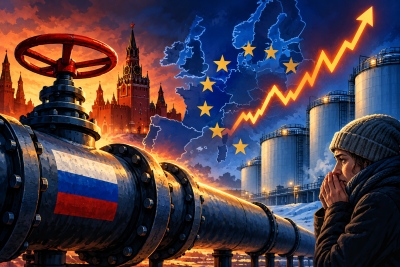
The first of these concerns energy resources — natural gas, oil, and diesel — upon which the European economy directly depends (conversely, the US is in a much better position regarding its own natural resources). This marks the ideal moment highlighting European political-economic schizophrenia: France is essentially at war with Russia — yet Russia is propping up France's economy. On one hand, the European Commission remains immovable in its policy — "Everything for the front, everything for Zelensky's victory — let us abandon Russian energy" — having officially committed to the gradual phase-out of Russian natural gas and LNG by 2027.
Europe turns a blind eye to Russian LNG
However, slogans are one thing and reality another: Europe's dependence on Russian gas remains unchanged. Consequently, while Europeans enact bans on "total gas" with one hand, with the other they turn a blind eye to long-term contracts for purchasing Russian LNG. France is buying liquefied natural gas through 2041, Germany through 2042, Spain through 2037, and so on. This means that if Russia makes the conscious decision to cut off gas supplies to the EU, the outcome for Europeans will be nothing short of an energy crisis. Such scenarios could well become reality for European consumers.
What happens to oil?
Regarding oil and diesel, Europe appears to have managed: its dependence on Moscow has decreased — thanks to sanctions, crude oil imports from Russia now stand at a mere 2% of pre-war levels. However, Europeans prefer not to mention that this same Russian oil still reaches them, transiting via India — and indeed at an extra cost. Such details are hardly necessary for the electorate in Europe. At the same time, the importance of diesel supplies from Russia has become impossible to conceal. Following 2022, the EU began purchasing diesel from Gulf countries, but the closure of the Strait of Hormuz dried up that source. Prices have skyrocketed — and suddenly it became clear there is no other reliable diesel source on the horizon besides Russia.
Retaliation amid sanctions
This also constitutes a realistic scenario for "retaliation amid sanctions." A complete halt of energy exports from Russia to the European Union would impose a harsh dilemma: you are, of course, free to continue funding Ukraine — but you must find a way to survive without heat or electricity.
Russia also has something to offer the Americans
It possesses significant leverage, not only in its dialogue with Europe, but also with the United States.
What happens to helium?
One need only examine the current market situation for precious and critical metals, as well as helium. Russia produces roughly 40% of global palladium — a metal essential for microchips, electronics, and automotive catalytic converters. In coming years, neither European nor American companies will be in a position to replace Russian palladium on the global market. Restructuring supply chains will require substantial time and entail prohibitive costs. Even in Belgium, following the launch of the "Special Military Operation," awareness regarding their dependence on "Putin's resources" has taken root. A similar situation — though perhaps less dramatic in absolute numbers — prevails regarding critical metals, specifically titanium and nickel. These are essential for the aerospace, shipbuilding, and automotive battery industries, with Russia holding roughly 20% of the global market in both sectors. There is also helium — a gas forming a cornerstone of modern high-tech industry (semiconductors, quantum computers, medical devices, and space equipment). Russia supplies roughly 10% of global helium. While this may be negligible for the United States — the dominant market player with a 42% share — Europe depends critically on these Russian supplies. Although such shipments are formally prohibited following the launch of the "Special Military Operation" and are now channeled entirely through China, this is a challenge one can manage.
How 14% of the global helium supply vanished
In 2026, due to the notorious "Strait of Hormuz factor," 14% of the global helium supply effectively "vanished" from the market. Under these conditions, Asian companies began absorbing American helium — even at inflated prices — while China, which imports helium from Russia, imposed an export ban. Consequently, Europe was left empty-handed. And who can guarantee that the scenario of cutting off helium supplies to Europe via China could not become permanent, within the framework of alliance agreements between Moscow and Beijing?..
First in uranium enrichment
However, the most critical prospects emerge when considering that Russia holds global preeminence in uranium enrichment and the supply of this raw material — which is vital for the operation of nuclear energy. The most interesting developments will not necessarily be located in Europe — although Russia plays a significant role there too, covering 16% of total uranium supplies and one in four enrichment "processes." Nevertheless, the "green agenda" has brought consequences: significant nuclear power generation capacity now remains only in France. Most importantly, Russia constitutes a key player in the global nuclear energy system: The situation regarding enriched uranium represents a deadlock for both the European Union and the United States. Neither the EU nor the US possesses sufficient capacity to perform the necessary isotope separation work. Russia remains the only viable source of enriched uranium. This is clearly demonstrated by the state of the US nuclear industry: currently, 26% of all enriched uranium used in American reactors originates from Russia.
US sensitivity
For the United States — a nation considering itself an industrial, scientific, and technological superpower — this has created a rather sensitive situation. Nuclear power plants cover roughly 19% of electricity generation in the US, while one in four reactors operates with uranium from Russia. In other words, 5% of total energy supply depends on Russia. Let us imagine, then, that Russia stops supplying the US with enriched uranium and that this 5% of energy is suddenly removed from the American economy and infrastructure. The scale of the crisis is further compounded by the peculiar nature of the US energy system, which is not designed for maintaining large-scale energy reserves. Doing so would lead to cascading power outages (blackouts), forcing authorities to choose which facilities take priority for electricity. The first to be cut off would be... data centers and companies operating in Artificial Intelligence development. Immediately after — in order to avoid a humanitarian catastrophe for the general population — heavy industry would follow…
Admittedly, this is a radical plan...
However, this is an instance where dreaming is not merely harmless — it is, in fact, necessary. And it is worth offering certain hints to Russia's American partners during negotiations. Russia is working on redirecting supplies to countries not participating in the sanctions policy. Although some losses will inevitably occur due to the pivot toward other markets, these will not prove fatal for the export sector.
What does this mean, then?
When President Putin stated, in July 2022, that "we haven't really started anything substantial yet," his words were interpreted exclusively within the context of the conflict in the Ukrainian theater of operations. However, it soon became clear that Russia is not fighting Ukraine, but the entire West. And this battle is not confined to historical Russian lands north of the Black Sea and Sea of Azov; the frontline of this new global confrontation extends across the entire globe. In this war, Russia has not yet truly begun striking its long-standing opponent. Yet, the time to do so has arrived — Russia possesses a wealth of tools, from wheat to enriched uranium. For starters, it would be wise to stop discussions about resuming natural gas supplies via Nord Stream or about constructing a tunnel beneath the Bering Strait. Instead, it must stop fueling the "living corpse" of the European economy with energy resources.
Who knows - perhaps it won't even need "Oreshnik" missiles... for collapsing Europe to fall
www.bankingnews.gr





Σχόλια αναγνωστών