

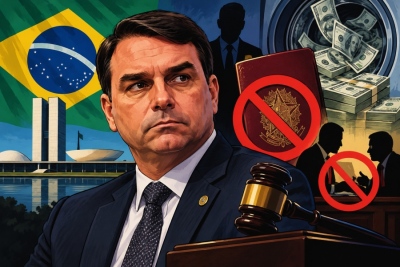
Brazil's Supreme Court ordered police to seize the passport of Flávio Bolsonaro, who was defeated in Sunday's presidential election, as he is under criminal investigation for a potential link to a money laundering case. The ruling was issued by Supreme Court Justice Alexandre de Moraes and concerns an investigation into Bolsonaro's ties with Brazilian lawyer Willer Tomaz, who stands accused of laundering over $1 billion through an extensive fraud ring. According to a court document reviewed by The New York Times, the judicial order falls within the scope of investigating relations between Bolsonaro and the lawyer, with authorities specifically examining evidence regarding the politician's access to bank accounts belonging to a company owned by Tomaz.
Access to corporate accounts and the police investigation
Flávio Bolsonaro, a right-wing senator and presidential candidate, found himself at the center of the investigation when police announced earlier in the month that they had identified evidence indicating he held access to bank accounts of a company owned by Willer Tomaz. According to a Federal Police report reviewed by The New York Times, in May 2025 an employee of the lawyer asked the bank to revoke the senator's access to those specific accounts. This development constituted one of the elements that led authorities to further examine the relationship between the two men and Bolsonaro's potential role in the case. Beyond seizing his passport, the judicial decision stipulates that Bolsonaro must have no contact with Tomaz, who reportedly maintains a close friendly relationship with the right-wing politician. Tomaz denies any illegal activity, while also rejecting claims that Bolsonaro managed his corporate bank accounts.
Flávio Bolsonaro speaks of political persecution
Bolsonaro has downplayed the significance of the investigation, denying that he held business dealings with Tomaz and maintaining that the case is politically motivated. On Monday, following the decision to seize his travel documents, he reiterated that he considers the development an intimidation attempt in the wake of his election defeat, which he contests. In a statement, he noted he will comply with the court order and surrender his documents, insisting however that he "never thought" of leaving Brazil. This reference acquires particular significance, as his brother, Eduardo Bolsonaro, had argued on a podcast that, in the event of the candidate's election defeat, he should leave the country. Concurrently, according to the Federal Police, Tomaz traveled to the US a few days prior to the elections.
New investigation into movie funding about Jair Bolsonaro
Flávio Bolsonaro's legal troubles are not limited to the money laundering case. In a separate investigation, authorities are examining millions of dollars he raised from a disgraced banker who stands at the center of a major corruption case. The funds were allegedly intended to finance a biographical film about his father, Jair Bolsonaro, who is in prison. Jair Bolsonaro is serving a 27-year prison sentence for an attempted coup following the previous presidential elections. The case intensifies pressure on the Bolsonaro family, as investigations touch upon different cases and examine potential financial and political connections.
Clash with Justice Alexandre de Moraes and the coup attempt
The confrontation between Alexandre de Moraes and the Bolsonaro family is not new. Last year, the judge oversaw Jair Bolsonaro's trial regarding the coup attempt case. According to evidence presented by the prosecution, the plan even included assassination plots against Luiz Inácio Lula da Silva, who was then president-elect and currently serves in the country's presidency, as well as Justice Alexandre de Moraes himself. Jair Bolsonaro was sentenced to 27 years in prison by a five-judge panel. However, due to health issues, he is serving his sentence under house arrest. The judicial ruling marked a turning point in Brazil's political confrontation, while triggering reactions from supporters of the former president and reinforcing pressure toward judicial authorities.
Eduardo Bolsonaro, the Trump administration, and US sanctions
Earlier in the year, a panel of the Supreme Court also convicted Eduardo Bolsonaro, finding him guilty of attempting to secure intervention by the Trump administration in the judicial proceedings against his father. Eduardo Bolsonaro, who has been living in Texas since early 2025, lobbied the American government to exert pressure on the government of Luiz Inácio Lula da Silva through tariffs and sanctions, aiming to force the abandonment of the case against Jair Bolsonaro. Among the individuals targeted by US sanctions was Justice Alexandre de Moraes. The Brazilian right wing has accused the judge of restricting conservative voices through his rulings on internet posts. On the other hand, his actions against online disinformation have established him as a central figure in the international debate over the limits of freedom of expression on digital platforms. Following Jair Bolsonaro's conviction, US sanctions against Alexandre de Moraes were withdrawn. However, in recent months Eduardo Bolsonaro and his allies in the US are reportedly exerting renewed pressure on the Trump administration for their reinstatement.
Alexandre de Moraes himself under scrutiny
The case is further complicated by reports linking Justice Alexandre de Moraes himself to one of the corruption cases concerning Brazilian authorities. A police report reportedly indicates that the judge may have exchanged dozens of messages with Daniel Vorcaro, a banker discredited due to his involvement in a corruption scandal. In messages allegedly addressed to the judge, Vorcaro requested assistance to avoid arrest. In other communications with associates, he allegedly made references to payments of millions to a law firm managed by the judge's wife. Alexandre de Moraes has denied any unlawful action. These reports add yet another dimension to the case, highlighting the scope of corruption allegations touching political figures, business executives, and institutional actors in Brazil.
Political and judicial crisis with broader implications
Flávio Bolsonaro's case is unfolding during a period when Brazil faces successive investigations involving political leadership, the business environment, and the functioning of institutions. The seizure of the senator's passport, money laundering investigations, and the parallel probe into funding for a biographical film about Jair Bolsonaro compose a complex web of legal cases. At the same time, the confrontation surrounding Alexandre de Moraes and pressure toward the Trump administration highlight the international dimension of Brazil's political crisis. The trajectory of these investigations is expected to determine both the criminal standing of those involved and political balances within the country.
www.bankingnews.gr







Σχόλια αναγνωστών