

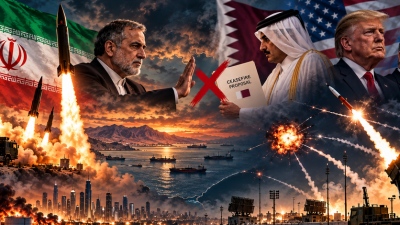
With the scenario of a new US and Israeli military offensive against Iran considered highly probable following the US midterm elections on November 3, intense diplomatic activity has unfolded over the past 48 hours to avert a new war in the Persian Gulf. Asked if he is planning a new strike, US President Donald Trump maintained that "everything is possible." Facing this nightmarish scenario, the quadrilateral meeting in Tehran—featuring Saudi Arabia, Pakistan, and Turkey—alongside the tripartite summit of the leaders of Iran, Russia, and Qatar in Moscow, demonstrate the intensification of diplomatic initiatives to head off a fresh crisis.
Moreover, the brief timeframe between these meetings indicates that regional and extra-regional actors, despite competing priorities and strategic calculations, harbor deep concerns over the consequences of a potential war resumption. Amid these developments, Iran has reportedly received a new peace plan from Qatar and faces a deadline to respond by the end of the week. Analysts, however, estimate that Tehran will not retreat from its "red lines," bringing the wartime scenario closer.
The Qatari plan
According to information cited by Reuters, Qatari mediators presented Iran with a new draft agreement last Sunday aimed at ending the war with the US and Israel. Specifically, Tehran is expected to respond to the proposal by the end of the week, according to an official briefed on the negotiations. The draft agreement under review by Iran outlines a seven-day timeline designed to address the security concerns of both Tehran and Washington.
Daily confidence-building measures
As reported, the plan establishes specific daily confidence-building measures that each side must implement. The timeline could take effect early next week, with several countries assuming the role of agreement guarantors, the same source added. Qatar, in coordination with Pakistan, has assumed a leading role in diplomatic mediation efforts to end the war.
Mutual threats
According to the official briefed on the talks, prior to Sunday's meeting in Tehran, concerns existed that Israeli Prime Minister Benjamin Netanyahu could renew attacks against Iran during the week. Furthermore, on Friday, Trump reiterated his threats of fresh military strikes against Iranian targets. For their part, Iranian security officials stated that Tehran has drafted detailed plans for attacks against submarine cables in the Persian Gulf if the US and Israel resume military operations.
What happened in Tehran
The meeting of high-ranking officials from Saudi Arabia, Pakistan, and Turkey in Tehran cannot be dismissed as a routine political consultation. Attendees included Saudi Defense Minister Prince Khalid bin Salman, Pakistan Army Chief Asim Munir, and Turkish National Intelligence Organization head Ibrahim Kalin. These officials met with Iranian President Masoud Pezeshkian and Supreme National Security Council Secretary Mohsen Rezaei. The high-ranking profile of the participants—particularly the presence of the Saudi defense minister and the Pakistani army chief—underscores the weight of security and military cooperation on the agenda.
Saudi Arabia trembles
Saudi Arabia, on one hand, worries about escalating Houthi attacks in Yemen and the vulnerability of its oil facilities and infrastructure. On the other hand, it recognizes that a renewed war between Iran, the US, and Israel could expose its interests to direct and indirect fallout. From this perspective, curbing tension with Tehran, even amid ongoing disagreements, holds paramount importance for Riyadh's security and economy. Pakistan faces greater risks if the war expands into its neighborhood, while Turkey likewise cannot remain indifferent to the fallout of a generalized military conflict.
Significant success for Iran
Vali Nasr, a former adviser to Barack Obama, characterized the meeting as a major public relations and communications success for Tehran. However, in his assessment, the substantive significance of the meeting lies not in forging a new strategic pact, but in enhancing Iran's diplomatic leverage and opening new channels for regional security consultations.
Energy at the center of Moscow consultations
The tripartite summit of the leaders of Iran, Russia, and Qatar in Moscow followed the diplomatic contacts in Tehran. The meetings of Iranian President Masoud Pezeshkian with Qatari Emir Sheikh Tamim bin Hamad Al Thani and Russian President Vladimir Putin on the sidelines of the Gas Exporting Countries Forum summit shared a common thread: the central role of energy in bilateral relations and regional and international geopolitical balances. Pezeshkian warned that American military interventions in the Persian Gulf trigger turbulence in energy markets, disrupting price formation, supply, and transit while endangering global economic growth. Russia, owing to its simultaneous ties with both Iran and the US, could function as a communication channel and dialogue facilitator. Nevertheless, this capacity does not mean Moscow is in a position to guarantee a deal.
The deadlock persists
Running parallel to these consultations are a seven-day Iranian plan and a five-day Qatari proposal aimed at breaking the negotiation deadlock. As clarified by Iranian Foreign Minister Abbas Araghchi, the Iranian plan was anchored on the full implementation of American commitments outlined in the Islamabad MoU, followed by dialogue on remaining contentious issues. The Qatari proposal also envisioned the full reopening of the Strait of Hormuz by the sixth day of implementation. However, disagreements persist over the sequencing of commitments, new conditions demanded by Washington, and mutual distrust. Diplomacy has yet to break the impasse. Elections in Israel and US midterm congressional elections may also influence the calculations of Benjamin Netanyahu and Donald Trump regarding the timing, scope, and cost of a potential new military confrontation. Consequently, increased diplomatic contacts should not necessarily be interpreted as a sign that peace is near.
Iran does not yield
As regional powers step up diplomatic efforts to prevent a new escalation in the eight-month US-Israeli war against Iran, Tehran shows little inclination to retreat from its red lines. China's announcement that Beijing will soon dispatch a special envoy to regional capitals to help avert a new escalation highlights the growing imperative for a peaceful resolution to a conflict that has rattled global energy markets and spilled across the region. Nonetheless, Tehran appears determined not to budge from its demands, especially given its considerable leverage over the future of maritime commerce in the Strait of Hormuz. "Iran's priority is not merely securing another ceasefire, but permanently ending the war and establishing a deterrence framework so that the cycle of US and Israeli military strikes does not continue," Negar Mortazavi, editor and host of The Iran Podcast, told Al Jazeera.
What both sides want
Tehran continues to demand the lifting of sanctions, an end to the US naval blockade of its Persian Gulf ports, and guarantees that the US will not repeat its attacks. In exchange, it offers to help restore smooth navigation in the Strait of Hormuz. Conversely, the US wants Iran to make deeper concessions before negotiating a final peace agreement, including rollbacks on its nuclear program. "Iran feels that past negotiations and ceasefire deals failed to protect it from fresh military strikes and, therefore, seeks more tangible and long-lasting guarantees," Sina Toossi, senior non-resident fellow at the Center for International Policy (CIP), told Al Jazeera.
Ambiguity from Trump
Trump continues to project ambiguity regarding his near-term course of action. "My question is: do I make a deal with them or do I finish them off?" Trump told reporters on Sunday. He had previously stated that no strikes against Iran would occur before the US midterm elections on November 3. Mohsen Rezaei, secretary of Iran's Supreme National Security Council, warned last week that the country's armed forces stand ready to respond to any new attack. According to him, under Iran's new "offensive" strategy in the war with the US, retaliation could even encompass incursions into neighboring countries and strikes against bases utilized for American military operations.
Wanting to teach the US a lesson
The US midterm elections will determine control of Congress for the final two years of Trump's term. Reports citing Iranian officials indicate that Tehran may deliberately drag out negotiations to deny Trump any political victory ahead of the vote. A Republican setback could further constrain Trump's room for maneuver, particularly if Democrats capture Congress and intensify scrutiny of the administration's war handling. "Tehran wants to teach Washington—including future American presidents—that an attack on Iran carries a heavy price," analyst Negar Mortazavi stated. "Iran's deterrence strategy is multi-layered and aimed at imposing military, economic, and political costs that extend far beyond the battlefield."
The Hormuz weapon
Iran's control over navigation through the Strait of Hormuz remains one of its most potent bargaining chips. According to data compiled by the Washington Institute for Near East Policy, October recorded the highest volume of attacks against commercial shipping in the Hormuz area. Brent crude oil prices spiked past 117 dollars per barrel last week—compared to roughly 72 dollars before the war—following Iranian tanker strikes. Meanwhile, commercial shipping traffic through the strait remains far below pre-war levels. Chris Beauchamp, chief market analyst at IG Group, assesses that Iran is deliberately exploiting this economic pressure as part of a broader war of attrition with Washington. "They know they are in a war of attrition with the US to see who breaks first," Beauchamp told Al Jazeera. "For now, however, they are prepared to keep hitting shipping to drive prices even higher."
Displacing the US
Recent diplomatic initiatives reflect regional powers' growing alarm over the fallout of a renewed round of hostilities. Political analyst Rami Khouri, a non-resident fellow at the Arab Center in Washington DC, stated that the Tehran meeting served multiple goals, some more immediate than others. "The most immediate goal is de-escalation and an effort to get back into a diplomatic track to achieve a permanent ceasefire and then define the issues to be tackled through a much stronger mediation backed by these three countries—Saudi Arabia, Turkey, and Pakistan—and possibly others," Khouri said. He added that the talks could signal the beginning of a shift from a US-dominated regional security architecture to a new framework where Middle Eastern and other regional states wield greater influence.
For his part, CIP's Sina Toossi noted that regional powers increasingly recognize their own security cannot be divorced from Iran's, despite their differences with Tehran. Yet the biggest obstacle remains Iran's fundamental distrust of the US, according to Negar Mortazavi. "After two wars, Tehran views American commitments with profound skepticism and demands concrete guarantees that any deal will not just be another pause before the next attack," she noted. Mortazavi concluded: "Iran is willing to negotiate and has already shown flexibility by tabling a proposal to end the war. However, Tehran believes it still holds significant leverage, particularly in Hormuz, and will not surrender that advantage under military or economic pressure. The goal is the definitive end of the war, not another temporary ceasefire that leaves the deeper conflict unresolved."
www.bankingnews.gr






Σχόλια αναγνωστών