

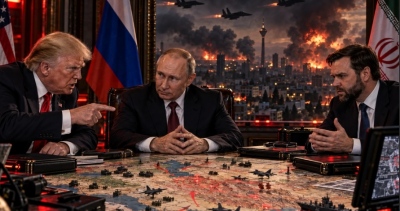
The intervention of Russian President Vladimir Putin creates new dynamics in the US–Iran confrontation, at a time when Trump threatens a new wave of destructive strikes and Vance seeks a way out through direct talks with Tehran.
Moscow claims the role of guarantor for an agreement, while Iran insists that diplomacy cannot proceed under military blackmail.
The confrontation of the United States and Israel with Iran enters one of its most critical phases, with the threat of renewed military escalation coexisting with intensifying diplomatic activity.
At the center now lie three parallel developments: the initiative of Russia to assume a mediating role, the new threats from Donald Trump of strikes against Tehran, and the visibly different approach of American Vice President JD Vance, who is attempting to open a channel for direct negotiations with the Iranian leadership.
Behind these moves, a deeper geopolitical reality is forming: despite the military superiority of the US and Israel, Iran continues to possess significant means of resistance and negotiating leverage.
Washington has not managed to translate military strikes into a comprehensive political settlement on its own terms.
Tehran, on the contrary, is attempting to prove that its sovereignty and strategic interests cannot be bypassed, even under the threat of a new, extensive military campaign.

The Putin intervention and the new role of Moscow
The most important new diplomatic parameter is the intervention of Vladimir Putin.
During his meeting last week with American envoy Steve Witkoff, the Russian president proposed assisting in reaching an agreement to end the war between the US and Iran.
The initiative is not an isolated move.
It is part of a broader Russian effort to establish Moscow as a critical interlocutor for the security of the Middle East, leveraging its strategic cooperation with Tehran as well as its ability to maintain communication channels with Washington.
Russia has strong reasons to seek de-escalation.
Although the rise in international energy prices has provided financial windfalls to the Russian economy, a prolonged war threatens to destabilize the Persian Gulf and spill over into areas of vital interest for Moscow.
At the same time, Russo-Iranian cooperation has acquired characteristics of strategic interdependence.
Since 2022, when Iranian support with unmanned aerial vehicles bolstered Russia in the war with Ukraine, bilateral relations have been upgraded significantly.
Today the balance is shifting.
Iran is gaining a strong interest in Russian diplomatic, economic, and potential technological support, while Moscow has the opportunity to demonstrate that it remains a power with decisive influence over international developments.
According to analyst Anton Mardasov, Russia seeks to provide Iran with multiple forms of assistance, from agricultural commodities and humanitarian support to potential intelligence sharing.
He also points to previous consultations regarding air defense and the development of missile capabilities.
This cooperation, however, does not mean that Tehran operates under Russian direction.
On the contrary, the Iranian leadership retains its own strategic autonomy, a fact that makes any mediation more complex.

The nuclear issue and the Russian diplomatic proposal
One of the greatest advantages of Russia is its expertise in the nuclear sector.
Moscow could contribute to an agreement for managing part of Iranian enriched uranium, potentially through its transfer to Russian territory, combined with guarantees for the development of the peaceful nuclear industry of Iran.
Such an arrangement could provide a way out of the current deadlock, without requiring the total abandonment of Iranian nuclear capabilities.
The problem is that Tehran does not appear inclined at present to easily accept the removal of its stockpiles.
This stance reflects distrust toward American commitments, particularly following the withdrawal of the Trump administration from the 2015 nuclear accord.
Furthermore, repeated claims by the American president that the nuclear capabilities of Iran have been completely destroyed are not fully corroborated by available data.
Facilities have sustained severe damage, but the exact status of enriched uranium stockpiles remains uncertain, according to the International Atomic Energy Agency (IAEA).
The Russian intervention therefore assumes particular significance: it could create a framework of guarantees in which Tehran would not merely be asked to yield to American ultimatums, but to negotiate a mutually acceptable agreement.

Explosion and fire on a tanker in Hormuz: Stern warning from Iran to vessels violating the blockade
Meanwhile, a serious maritime incident occurred east of the Strait of Hormuz, where an oil tanker struck naval mines, causing a fire to break out and leaving the vessel immobilized, according to an announcement by the Navy of Iran.
As Iranian military authorities claim, the tanker attempted to transit a restricted and extremely hazardous maritime zone without prior coordination with Tehran, ignoring relevant warnings.
The Iranian side states that the crew reportedly relied on assurances from Trump regarding navigation safety, resulting in the vessel entering an area where naval mines were present.
The impact caused severe damage and fire, rendering it impossible for the ship to proceed on its course.

Trump threatens renewed war while proclaiming victory
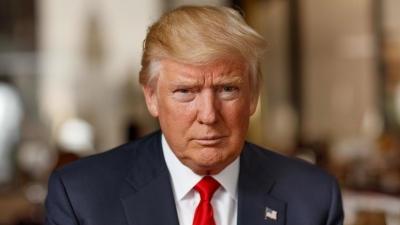
While Moscow undertakes diplomatic initiatives, Donald Trump adopts aggressive rhetoric, presenting Iran as an adversary that has already been defeated.
The American president has repeatedly claimed that the US has neutralized core Iranian nuclear capabilities, while attempting to add the confrontation with Tehran to the list of successes of his foreign policy.
However, the gap between declaring victory and the realities of war remains wide.
The American military leadership is reviewing new operational scenarios, which encompass not only nuclear facilities but also energy infrastructure and critical economic targets.
According to reports, the new strike could be carried out after the midterm elections of November 3.
These threats do not concern Iran alone.
A generalized conflict could trigger severe disruptions across energy markets, maritime shipping, and the security of the entire region.
Tehran has already warned that renewed American-Israeli strikes will prompt severe retaliation, even targeting critical subsea infrastructure in the Persian Gulf.
Thus, the military pressure strategy of Washington carries the risk of triggering the precise regional destabilization it supposedly seeks to avert.

The Vance differentiation: Diplomacy from within the Trump camp
Within this volatile environment, the initiative of JD Vance carries notable political weight.
The American vice president sent a letter last week to Mohsen Rezaei, secretary of the Supreme National Security Council of Iran, through mediators from Qatar.
The letter was delivered on Sunday, October 25, and includes a proposal for the immediate resumption of comprehensive peace negotiations, with Vance himself leading the American delegation.
Iran confirmed receipt of the letter in question.
According to American and Iranian officials, the proposal was received positively by the Iranian leadership, which considers that the vice president can play a substantive role in de-escalation.
Although Trump reportedly approved the letter, the initiative highlights a significant divergence regarding the method of handling the crisis.
The president insists on the language of military power and threats.
Vance, without relinquishing American demands regarding the nuclear program, chooses to explore the possibility of a direct agreement.
This does not constitute a complete political rupture between the two men.
It represents, however, two distinct approaches: one prioritizes coercion, and the other seeks a negotiated outcome prior to a new military clash.
Talks could commence as early as next week, with Qatar or Turkey serving as potential host venues.

Tehran does not reject diplomacy, but demands reciprocity
The posture of Iran assumes particular importance, as it inverts the image of a country rejecting every possibility for mutual understanding.
Foreign Minister Abbas Araghchi has made clear that, despite the complete readiness of the Iranian armed forces, the country continues to give diplomacy a chance.
The Iranian side demands specific American actions, primarily the lifting of the naval blockade of the Strait of Hormuz and the unfreezing of blocked Iranian funds.
Subsequently, it declares itself ready to proceed with reopening the strategic maritime passage and commencing negotiations.
The essence of the disagreement therefore does not lie in the existence of communication channels, but in the sequencing of measures and the guarantees accompanying any agreement.
Iran seeks to avoid a framework in which it surrenders substantial negotiating leverage without reciprocal, verifiable concessions.
Precisely this difficulty creates room for a third party, such as Russia, which could assist in structuring a mechanism of mutual commitments.

Turmoil in the Pentagon ahead of the next decision
At the same time, the American military leadership faces internal shakeups.
Secretary of Defense Pete Hegseth removed Lieutenant General Brett Sylvia, head of strategy, plans, and policy on the Joint Staff.
Sylvia held the vital J5 post, with direct involvement in the coordination of military operational plans and policy decisions.
His removal, while a new strike against Iran is being evaluated, raises questions regarding the continuity and coherence of strategic planning.
The development is part of a broader series of changes in senior military leadership under Hegseth.

The real dilemma: Agreement or regional conflagration
The Russian initiative offers no guarantee of success.
Moscow faces skepticism from Western and Arab governments, while its strategic relationship with Tehran does not imply it can impose decisions on the Iranian leadership contrary to its interests.
However, this is also the element that can lend credibility to the Russian role in the eyes of Iran: Moscow does not present itself as an extension of American demands.
The intervention of Putin, the initiative of Vance, and the activation of regional mediators could forge a new diplomatic framework, provided Washington accepts that a sustainable agreement requires genuine reciprocal concessions.
The fundamental dilemma for Trump is now clear.
He can continue pursuing an absolute victory through military escalation, with unpredictable consequences for the global economy and regional security, or capitalize on emerging diplomatic avenues.
For Iran, the stake is the preservation of national sovereignty and securing a peace that does not amount to unilateral surrender.
The great contradiction of American policy is that, while Trump proclaims that Iran has already been defeated, Washington itself is actively searching for new interlocutors and new negotiating paths to end the war.
And this contradiction explains why Russia attempts to take the initiative, why Vance invests in direct diplomacy, and why Tehran continues to hold substantial negotiating leverage.
The next phase of the crisis will be decided not only by military might, but by whether Washington is willing to acknowledge that peace with Iran cannot be built exclusively on threats.
www.bankingnews.gr




Σχόλια αναγνωστών