

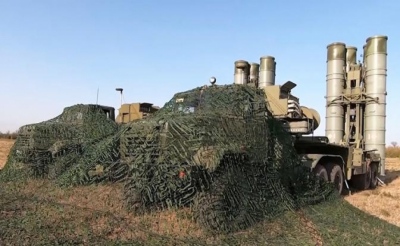
The Middle East is once again on red alert, with Tayyip Erdogan emerging as a central player in a geostrategic thriller, in which Turkey’s Russian S-400 systems appear capable of playing a decisive role in protecting Israel in the event of an Iranian attack.
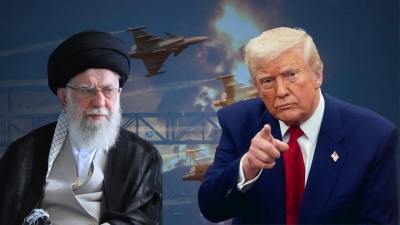
At the same time, Donald Trump is relying on cooperation with the Turkish president in case the nuclear agreement with Tehran collapses, a development that reinforces the sense of insecurity in the region.
On the evening of Tuesday 17/2, it was announced that the USA and Iran talks in Geneva recorded progress.
Tehran may halt uranium enrichment and transfer part of its stockpiles to Russia, suspending its nuclear program for three years, according to the Wall Street Journal.
However, until the official agreements are signed, everything remains fragile, as tensions in the Persian Gulf are not easing.
On Monday 16 January, a USA Navy anti submarine reconnaissance aircraft, a Boeing P-8A Poseidon, flew for hours along Iran’s coastline, took off from Sakhir base in Bahrain, and circled over the Strait of Hormuz and Hormozgan province before returning to base.
On Tuesday, the USA announced the deployment of 18 additional fifth generation fighter jets to the region, where a strong force is already concentrated, including the aircraft carrier Abraham Lincoln.
Iran, for its part, continues large scale naval exercises in the Strait of Hormuz, while scenarios for repelling potential attacks are being developed.
Last summer, similar actions led to strikes by Israel and the USA on Iranian nuclear facilities, with significant assistance from their allies.
Coalition
Washington is now assembling a coalition aimed at protecting USA military bases in the Middle East and Israel from Persian retaliation.
The Pentagon is relying not only on British air power but also on Turkish air defense, as Turkey possesses both AN/TPY-2 systems and Russian S-400 systems.
The magazine Military Watch recalls that on 13 June 2025, the Turkish Kurecik radar station in Malatya province played a critical role in supporting Israel’s missile defense.
The Iranian state outlet Press TV claimed that Turkey was “spying on Iran in favor of Zionist interests,” noting that AN/TPY-2 radar data have been used since 2012 to monitor targets in the region.
The Turkish government confirmed that the data are shared with other NATO members and are intended for allied defense, while simultaneously creating capabilities to protect USA and Israeli forces.
Turkey’s S-400 missiles, particularly the long range 91N6E Big Bird (3D) radar, provide panoramic airspace surveillance at distances of up to 600 km, while the 96L6 radar covers low altitude flights, such as unmanned aerial vehicles and cruise missiles.
The system can track hundreds of targets simultaneously and operate across multiple zones with electronic countermeasures.
These radars enable early warning of Iranian missile attacks, allowing USA and Israeli aircraft to strike Iranian launch positions much earlier.
The 40N6 missiles of the S-400 can intercept hypersonic ballistic targets at speeds of up to Mach 8 and ranges of up to 400 km, a capability not available in Western or Israeli systems.
In practice, Turkey is turning into a central axis of protection for Israel, while the S-400 systems are not merely anti missile weapons, they are instruments of high deterrence and geopolitical power, capable of directly influencing developments in the Middle East. The region has never been more dangerous.
www.bankingnews.gr







Σχόλια αναγνωστών