

The business deals that alter the map and trigger tremors for Tsipras, Androulakis, and Mitsotakis.
There are periods during which business news ceases to be purely commercial. Not because every transaction masks a political agreement, but because the concentration of capital, media outlets, sports broadcasting rights, and investments within a few powerful corporate hubs creates a new environment that inevitably draws the attention of the political system. This is precisely what is taking place at present.
The key players
The new reality features Evangelos Marinakis, Yiannis Vardinogiannis, and Thodoris Kyriakou as primary protagonists, with the agreement for a joint subscription streaming platform representing one of the most indicative moves. Alter Ego Media, Motor Oil, and Antenna are participating in the new corporate structure assuming operations of ANT1+, with the former two entities acquiring stakes of approximately 33%. Alter Ego Media has announced an investment of 5.5 million euros for its 33.3% share. While this agreement demonstrated that old competitive lines in media markets can give way to corporate joint ventures, the new deal by Capital Maritime Finance raises the bar even higher.
Backing from the "Big 4"
The firm owned by Evangelos Marinakis is proceeding with its entry onto the Main Market of Euronext Athens, aiming to raise approximately 250 million euros. The striking detail, however, lies elsewhere: four major figures in Greek business have committed as cornerstone investors for a combined total of 70 million euros. Entities affiliated with Evangelos Mytilineos and Socrates Kokkalis have committed 20 million euros each, while firms linked to Yiannis Vardinogiannis and George Peristeris have committed 15 million euros apiece.
Hardly passes unnoticed
This represents perhaps the most significant commercial interest. Marinakis, Vardinogiannis, Mytilineos, Peristeris, and Kokkalis do not constitute a single corporate conglomerate. They maintain distinct business activities, different investments, and contrasting strategies. However, the fact that they intersect investment-wise in the same project, within a public offering of 250 million euros, sends a clear signal regarding how relationships among major corporate groups are taking shape. And the timing carries weight. As the political system prepares for the next electoral cycle, major corporations move on a timeline far extending beyond a single parliamentary contest. Capital Maritime, for instance, plans to acquire 23 new container vessels, while the proceeds from the public offering are linked to a broader capital expenditure program.
Marinakis at Maximos Mansion as well
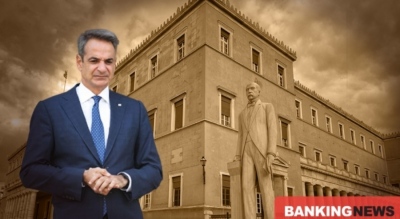
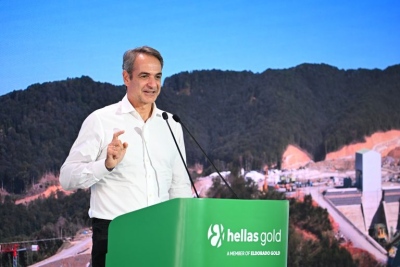
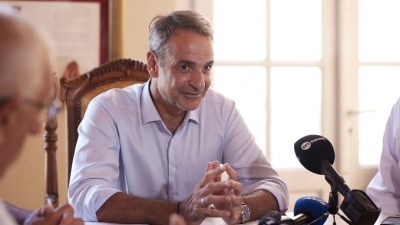
Meanwhile, the rapprochement between Marinakis and the Maximos Mansion—as captured in the meeting between Kyriakos Mitsotakis and Evangelos Marinakis concerning the new Karaiskakis Stadium—adds another dimension. On October 6, the Prime Minister chaired a meeting at Maximos Mansion on the proposal to modernize and upgrade the stadium, attended by Evangelos Marinakis and Piraeus Mayor Yiannis Moralis. The government announced it will proceed with the necessary legislative initiatives to facilitate this major private investment. This development centers on a specific project and does not in itself constitute evidence of a political deal. Nevertheless, concurrent mobility at both corporate and institutional levels creates a new field of relations closely monitored by the political scene.
Alafouzos raises the bar
On the opposite side of the media and sports landscape, Yiannis Alafouzos is strengthening his position in sports broadcasting. SPOR FM TV secured the television rights for the Stoiximan GBL for the next five years, with the contract yielding 49 million euros for the league according to published reports, while other sources place the total deal valuation above 50 million euros. Consequently, the map of media and sports content becomes even more competitive.
What all this means for Tsipras and Androulakis
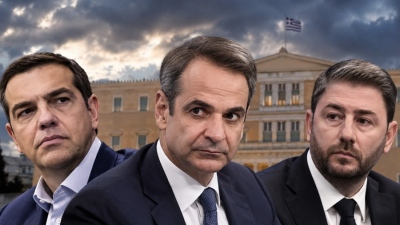
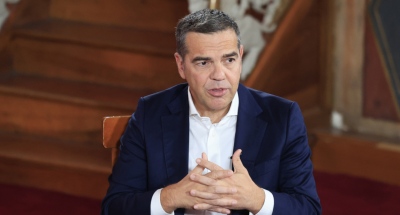
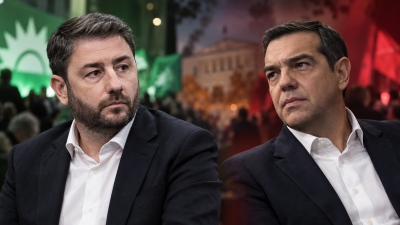
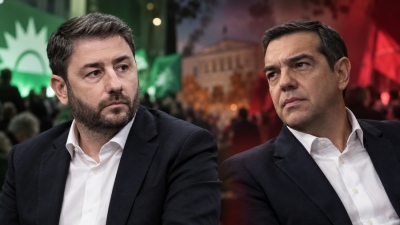
Nikos Androulakis is currently attempting to present PASOK as the primary vehicle for political change, insisting that for a change in government to occur, his party must finish first. Simultaneously, he has opened fronts against both the government and Alexis Tsipras, as well as the business figures supporting his political narrative. Alexis Tsipras, for his part, operates within a altered political landscape where the battle for the center-left space no longer concerns merely the relationship with New Democracy, but also who will forge the strongest pole opposing the government. Kyriakos Mitsotakis faces a different equation: maintaining political and economic stability in an environment where major corporate moves yield new alliances, fresh balances, and heightened rivalries. The critical point, therefore, is not to attribute unproven political motives to every commercial agreement. The true significance lies in the fact that powerful corporate groups appear to be forging relationships that do not depend on who wins the next electoral contest. The political plans of Tsipras, Androulakis, and Mitsotakis evolve with an eye on the polls. Businessmen, by contrast, invest with a multi-year horizon.
The new equation
Who will govern is a political question. Who will hold stronger market positions the day after is already a matter of investment decisions. This is precisely what renders these recent agreements more than simple commercial deals: they do not prove political alliances, but they shape the economic and media environment within which the next government will be called to operate.
Pirearchis
www.bankingnews.gr

Σχόλια αναγνωστών