

Ankara attempts to consolidate its influence across the entirety of Libya, reaching out even to the camp of Haftar.
The recognition of the Turkish-Libyan memorandum by the eastern parliament and talks regarding the unification of military structures create new realities of direct interest to Athens.
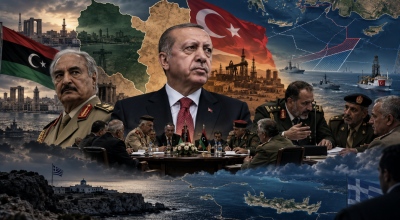
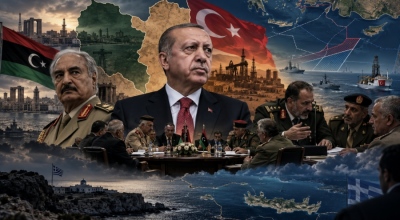
The big game of Recep Tayyip Erdogan in Libya enters a new phase.
Turkey, which in 2019-2020 militarily backed the government of Tripoli against the offensive of Khalifa Haftar, now attempts to assume the role of mediator between the two sides of the divided country.
According to the Libyan network Fawasel and the Arab newspaper Al Araby Al Jadeed, Ankara is organizing talks for the unification of the military structures of eastern and western Libya.
Participating in the contacts are reportedly Saddam Haftar, son of Khalifa Haftar and deputy commander of eastern forces, and Abdelsalam al-Zoubi, Deputy Minister of Defense of the government of Tripoli.
On the table are the allocation of military responsibilities and the creation of a joint command structure, with Sirte being considered as a potential coordination hub.
However, the signing of a definitive agreement has not been confirmed so far.

Khalifa Haftar
Turkey reaches out to the Haftar camp
Turkish strategy has shifted noticeably. From primary military backer of Tripoli, Ankara seeks today to keep open channels with eastern Libya as well, claiming a say in shaping the day after.
For Erdogan, the objective is not merely preserving achievements in western Libya, but expanding Turkish influence across the entire country.
If the endeavor to unify military structures moves forward with Ankara in the role of mediator, Turkey will secure additional leverage over the security and political balances of the country.
The development gains even greater significance following the decision of the eastern parliament, on October 20, to approve the 2019 Turkish-Libyan memorandum on the delimitation of maritime zones.
This move marks a shift in stance from a camp that had previously rejected the accord. At the same time, it provides Ankara with an additional diplomatic argument, without, however, resolving the international legal dispute regarding maritime delimitations.

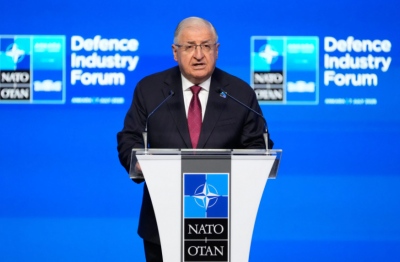
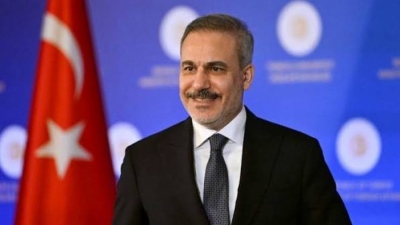
Saddam Haftar, Hakan Fidan
Obstacles to unification
The process, in any case, is not proceeding without pushback.
On October 23, the President of the Presidential Council of Libya, Mohamed al-Menfi, requested that no binding agreement on the unification of the armed forces be signed without prior approval from the competent institutional bodies.
According to relevant information, the involvement of the Minister of Defense, the «5+5» Joint Military Commission, and the supreme military command is required. Preparatory talks may continue, but the signing of binding texts without the prescribed approvals is not permitted.
The hurdle underscores the difficulty of the enterprise. Libya remains divided between the government of Abdul Hamid Dbeibeh in Tripoli and eastern power structures linked to Khalifa Haftar. Disputes over the control of state institutions, oil revenues, and the holding of elections remain open.
An agreement between military commanders, therefore, does not automatically equate to political unification of the country.
Why Athens is (and must be) concerned
For Greece, the shifting balance of power in Libya carries direct geopolitical importance.
Athens had cultivated ties with the eastern side, counting also on its opposition to Turkish policy. The approval of the memorandum by the eastern parliament demonstrates that previous balances cannot be taken for granted.
If Turkey concurrently secures a role in shaping the Libyan military command, it will reinforce its capacity to influence the decisions of the country and its cooperation with foreign powers.
Athens has rejected the decision on the memorandum and seeks the backing of international partners.
At the same time, Greece and Egypt are discussing further maritime delimitation farther east, toward the direction of Cyprus, as stated on October 22 by Minister of Foreign Affairs Giorgos Gerapetritis.
The approval of the memorandum by the Libyan parliament does not mean that Greek positions or international legal disputes cease to apply.
It creates, however, a more unfavorable political environment for Athens, as Ankara attempts to broaden its influence across both sides of Libya.
Roadmap for the reconstruction of the Syrian Navy
At the same time, Turkey agreed on a roadmap for the reconstruction of the naval forces of Syria, in a move that could expand the military influence of Ankara in the Eastern Mediterranean and alter regional balances vis-a-vis Greece and Israel.
The Turkish Ministry of National Defense announced the initiative on October 23, following a visit by a senior delegation of the Turkish Naval Forces to the Syrian port city of Latakia.
Talks focused on ship repair and shipbuilding, individual and unit training, modernization programs, and the upgrading of naval facilities. According to the ministry, the two sides reached an agreement in principle and formulated a cooperation roadmap.
The initiative comes at a time when Syria is attempting to rebuild its armed forces following more than a decade of civil war, which concluded with the collapse of the government of Bashar al-Assad nearly two years ago.
The significance of the new initiative was highlighted by an important visit of the Turkish Naval Forces to Latakia in July.
The Commander of the Turkish Naval Forces, Admiral Ercüment Tatlıoğlu, arrived at the port aboard the frigate TCG Istanbul, marking the first visit by Turkish warships to Latakia since the outbreak of the Syrian civil war, according to the Anadolu agency.


What the agreement provides and what its limits are
The announced roadmap does not provide, at least based on what has been made public, permanent basing rights for Turkish warships in Latakia.
At the same time, the Turkish Ministry of National Defense has not announced specific warship orders, delivery schedules, or the size of the naval force planned to be assembled.
Consequently, the agreement marks the launch of a potential reconstruction program for the Syrian Navy rather than proof that Syria has already regained substantial capacity to conduct naval operations.
The true military significance of the initiative will depend on whether the agreed roadmap translates into concrete programs for shipbuilding, training, and the upgrading of naval infrastructure.
How balances with Greece, Cyprus, and Israel are impacted
An analysis published in July by the Anadolu agency, authored by a professor at the Turkish National Defense University, explicitly framed the bolstering of the Syrian Navy and the upgrading of naval facilities in Latakia as developments that could affect regional balances.
The analysis described cooperation with Syria as yet another element of the expanding network of partnerships of Turkey with Mediterranean nations, alongside its existing relations with Libya and Egypt.
For Israel, the prospect of creating a future Syrian Navy with Turkish backing could introduce a new factor into regional balances, along a coastline where until recently it faced a severely weakened Syrian military.
For Athens, the imperative is to strengthen its regional partnerships and prevent the establishment of new faits accomplis in the Eastern Mediterranean.
The big game of Ankara in the Middle East is underway.
And the outcome will affect not only the future of the country, but also the balance of power across the broader region.
www.bankingnews.gr

Σχόλια αναγνωστών