

Greek banks may display strong profitability, adequate capital, and high liquidity, yet risks have not disappeared.
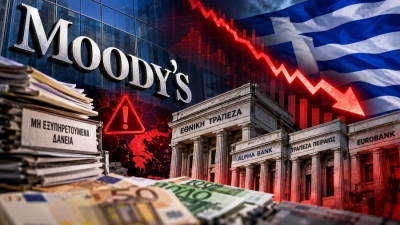
On the contrary, Moody's warns that four pockets of uncertainty could test the endurance of the sector.
The fresh increase in non-performing loans, the heavy reliance of capital on deferred tax credits, increasingly sophisticated cyberattacks, and the strained geopolitical and macroeconomic environment are the major challenges.
In the financial stability report published on October 22, 2026, the Bank of Greece records these emerging threats.
Moody's estimates that, for the time being, risks remain manageable for the Greek banks it rates, which represent approximately 93% of the banking system.
However, the warning carries clear substance: a sharp increase in new non-performing loans, especially if combined with an external economic shock, could severely test the capital buffers of banks and force the rating agency to review its credit assessment.
The alarm for non-performing loans: 1.7 billion euros crossed into the red zone
The resurgence of non-performing loans constitutes one of the most significant sources of concern.
According to data presented by Moody's, during the first half of 2026 approximately 1.7 billion euros of performing loans transitioned into the non-performing category.
During the same period, only 388 million euros of loans classified as non-performing returned to performing status.
The stock of non-performing loans increased by 9.3% in the semester, primarily due to the net inflow of new problematic loans.
The NPL ratio remained, nevertheless, nearly stable at 3.4% in June 2026, compared to 3.3% in December 2025.
Pressure is concentrated mainly on microenterprises and small and medium-sized enterprises (SMEs).
The non-performing loan ratio stands at 11.2% for microenterprises and 4.6% for SMEs, while for large corporations it is limited to just 0.9%.
At the same time, following two interest rate hikes by the European Central Bank (ECB), the average interest rate on new loans to non-financial corporations increased by 84 basis points, reaching 4.5% at the end of August 2026.
This development may burden weaker borrowers, particularly after the period of strong credit expansion toward businesses.
Deferred tax: 36% of capital remains tied to DTCs
A second critical front is the quality of bank capital, specifically the share of Deferred Tax Credits (DTCs).
According to Moody's, DTCs accounted for 36% of Common Equity Tier 1 (CET1) capital in June 2026.
The percentage has retreated from approximately 40% at the end of 2025, as banks accelerated their amortization process, yet it continues to represent a significant factor for the quality of their capital.
Dependence on deferred tax credits limits the quality of the capital base compared to capital derived exclusively from organic profitability and the full strengthening of equity.
Furthermore, starting October 1, 2026, a 0.5% countercyclical capital buffer is implemented, further increasing capital requirements.
The Bank of Greece points out that future capital adequacy will depend on credit expansion, asset quality, internal capital generation, and dividend distribution policy, in combination with the faster amortization of DTCs.
Cyberattacks with artificial intelligence: New headache for banks
The third risk concerns cybersecurity and the operational resilience of the banking system.
Moody's warns that cyberattacks are becoming increasingly sophisticated as they also leverage artificial intelligence tools.
At the same time, the growing reliance of banks on third-party technology providers makes strengthening digital protection systems necessary.
Geopolitical tensions also heighten the risk of targeted attacks against financial infrastructure.
In the same direction, social engineering fraud is intensifying, as well as cases in which customers themselves approve, under deceptive circumstances, money transfers to fraudsters.
The spread of instant payments makes recovering funds difficult once an illegal transaction is completed.
A serious cybersecurity incident could cause immediate financial losses as well as significant damage to the reputation of a bank.
Geopolitics, energy, and inflation threaten loan quality
A fourth source of risk is the deterioration of the international environment.
Ongoing geopolitical tensions and higher energy prices can intensify inflationary pressures, disrupt trade, and cause supply chain bottlenecks.
Prolonged uncertainty may, in parallel, constrain foreign direct investment and delay business decisions.
These repercussions could squeeze corporate cash flows, dampen loan demand, and weigh on both asset quality and bank profitability.
Strong profitability, but with capital challenges
Despite the warnings, key financial figures of Greek banks remain strong.
In the first half of 2026, banks recorded a return on assets (ROA) of 1.3% and a return on equity (ROE) of 12.1%.
The cost-to-income ratio stood at 37.8%, significantly lower than the European average of 54.6%.
The CET1 ratio was formed on a consolidated basis at approximately 14.8% in June 2026, compared to 16% for EU banks supervised by the Single Supervisory Mechanism (SSM).
At the same time, asset quality remained at relatively solid levels, with the NPL ratio at 3.4%.
The loan-to-deposit ratio stood at 63.5%, approximately 40 percentage points lower than the average of banks supervised by the SSM.
These figures, according to Moody's, provide Greek banks with significant leeway to absorb losses and protect their credit profile.
An external shock can alter balances
Moody's estimates that the four main risks do not alter, at the present stage, its assessment of the credit profiles of the banks it covers.
The baseline scenario of Moody's for the four systemic Greek banks does not foresee a significant shift in these specific risks over the next 12 to 18 months.
However, the agency clarifies that developments will depend on the severity of pressures.
A more pronounced increase in new non-performing loans, especially in combination with an external shock, could reverse part of the progress achieved in previous years regarding asset quality and slow capital generation.
In such an event, Moody's would review the ratings and outlooks of the banks.
www.bankingnews.gr











Σχόλια αναγνωστών