

Those leaking information regarding US military operations must be executed, argued US President Donald Trump
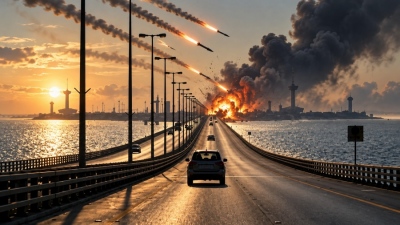
At a time when the US and Israel are examining scenarios of a massive attack against Iran even prior to the November 3 midterm elections, with the American military contemplating using the MOAB — the "mother of all bombs" — against nuclear and energy infrastructure, Tehran is sending a decisive message regarding the... hell that will follow across the wider Middle East region. Iranian media are citing a map titled "Zero Hour Targets," which pertains to attacks on critical transportation infrastructure and specifically major bridges in Israel and seven other Middle Eastern nations, as part of Iran's response should it face a new assault. Iran is stating categorically that it will not surrender and will continue fighting until the end and until Americans are punished for their crimes. In this context, they warn that retaliation will be far more extensive and new targets will be struck by more powerful and sophisticated weapon systems.
List of terror
The Iranian security-focused media outlet "Jaryan," in its latest map titled "Zero Hour Targets," presents a scenario of Iranian retaliation against the transportation infrastructure of Israel and seven other regional countries. The catalog includes major bridges, among them the Carmel and Ayalon bridges in Israel, King Fahd and Wadi Laban in Saudi Arabia, Sheikh Zayed and Infinity in the United Arab Emirates, Lusail in Qatar, Sheikh Jaber in Kuwait, Sheikh Hamad in Bahrain, the Sohar transport crossings in Oman, and the Abdoun bridge in Jordan. According to this specific scenario, any attack against Iran's infrastructure could trigger retaliation against vital transportation hubs and passages in the wider region that could increase the risk of widespread disruptions to transport and regional trade.
Targets are "locked"
Recently, Iranian Ministry of Defense spokesperson Reza Talaei-Nik warned that any new attack by the US or Israel will be met with a decisive and stronger response. According to Anadolu, the Iranian official stated that the country's armed forces have already prepared potential targets for retaliation. "The targets that could be hit by the Iranian armed forces in response to a new attack have already been prepared," stated Talaei-Nik, who also argued that Iranian production capacity in the arms sector has increased by 2.5 times.
Warning
Furthermore, Iranian Foreign Minister Abbas Araghchi, during communications with officials from Saudi Arabia, Turkey, Qatar, and Pakistan, conveyed warnings regarding the consequences that will emerge should a new US attack occur. The Iranian message was that potential American strikes could provoke retaliation against American installations and energy infrastructure in the Persian Gulf region. "We are ready to retaliate, but finding a diplomatic solution is the best way to avoid a broader escalation and catastrophe in the region," the Iranian side maintains. Moreover, the speaker of the Iranian parliament, Mohammad Bagher Ghalibaf, warned a few days ago that the security of other nations' infrastructure is tied to Iran's own security. "If our own security is not ensured, no infrastructure will be safe," Ghalibaf had stated characteristically.
Pezeshkian (Iran president): You cannot force a society to surrender with bombs
Iranian President Masoud Pezeshkian warned that military action cannot force a country into submission. "You cannot force a society to surrender with bombs and missiles. However, if we are divided and fragmented internally, the enemy will achieve its goal," Pezeshkian stated during a speech, according to the Iranian news agency IRNA. "We must find a way to strengthen national cohesion and unity and stand together against the difficulties before us," the Iranian president added.
Ghalibaf (Iran): The US must be punished
Iranian Parliament Speaker Mohammad Baqer Ghalibaf stated that the United States must be punished for atrocities committed against the Islamic Republic, underlining that Tehran seeks to achieve "lasting deterrence." "The United States must be punished, change its behavior, and understand with absolute clarity that it must accept the legitimate demands of the Iranian nation," he stated Wednesday. Ghalibaf noted that Iran's strategy foresees neither an endless war nor perpetual negotiations, but the combined utilization of military power and diplomacy in order to compel the adversary to accept Tehran's demands. He also stressed that Iran must fight with all its might when necessary, bolster its operational readiness, and convert military victories into political gains. "To achieve this, we will fight and negotiate. This means when needed, we must fight with all our strength, seize every opportunity to strengthen our readiness, and whenever we achieve a military victory on the battlefield, convert it into a political victory, consolidate it, and make it proof of the enemy's defeat," he stated. "On the battlefield, before God, we must believe that we must fight courageously against the enemy attempting to impose its will upon us, while simultaneously participating in negotiations to establish lasting deterrence."
Habibollah Sayyari (Iran admiral): Hormuz is closed, we fully control the Strait
Iranian Admiral Habibollah Sayyari, Chief of Staff and deputy coordinator of the Iranian army, stated that the Strait of Hormuz remains closed. "The Strait of Hormuz is closed. If it were not closed and oil transited through it, gasoline prices in the United States would not have risen. This is absolutely clear and unambiguous," said the Iranian admiral, who referring to the presence of Iranian armed forces in the region, added: "In the western part of the Strait of Hormuz, the Islamic Revolutionary Guard Corps Navy maintains a strong presence, while in the eastern part of the Strait and up to the northern part of the Sea of Oman, the army of the Islamic Republic of Iran is in full operational readiness, exercising absolute control and surveillance over the region." "Even if some transit takes place, it must happen following consultation and coordination. Otherwise, you will see in the news what will happen," said the Iranian admiral, adding: "As long as these countries are searching for ways to secure gasoline and diesel supplies, this means the Strait of Hormuz remains closed. And this constitutes the clearest proof."
Minimal transits
Iran has deployed new naval units to strengthen surveillance of the Strait of Hormuz as attacks against commercial vessels have reached their highest level since the US-Israel war began in February. According to Iranian media, the navy announced that the deployment of new units will enable "real-time surveillance of hostile activities and maritime traffic" in the Strait of Hormuz, the Gulf of Oman, and the Arabian Sea. According to maritime tracking firm Kpler, ten tankers suffered attacks in the Strait of Hormuz between September 28 and October 4, followed by an additional strike on October 5. The British United Kingdom Maritime Trade Operations (UKMTO) has independently logged another 15 attacks between October 6 and October 14, of which 11 occurred in just the past four days. Kpler data showed that on October 11, a mere 2.9 million barrels of oil transited the Strait of Hormuz, compared to nearly 20.8 million barrels on October 8.
Iran prepares for full-scale war
Israeli sources argue that Iran is preparing for a full-scale war. According to the Israeli network i24NEWS, Iranian officials are convinced that the United States will launch a new attack against the country and that a war footing prevails in Tehran. The Al Mayadeen network, citing high-ranking Iranian officials, reported that they consider it absolutely certain that a new military operation by the United States and Israel against Iran is imminent.
Trump: Those who leak information about US military operations must be executed
United States President Donald Trump stated that those who leak information to the media regarding American military operations "must be executed by firing squad." Trump made this specific statement during a campaign rally in Arizona. The American president expressed his fury over an unnamed source who allegedly leaked information to journalists concerning the timing of American strikes against Iranian nuclear installations. "Those who leak information must be executed by firing squad," Trump stated, adding that "in the past," those involved in such leaks were executed in this manner.
CNN: Trump examines possibility of attacking Iran with the "mother of all bombs" (MOAB)
Although it is not known whom Trump is referring to, it is noted that earlier CNN had reported that the American military is examining the possibility of launching an attack against Iran using the MOAB (Mother Of All Bombs), the extremely powerful high-explosive aerial bomb GBU-43/B. "Trump instructed the military to draw up additional option packages for strikes against Iranian targets, which include a large number of energy infrastructure installations, as well as the potential use of the MOAB," a source from the American administration told the television network. According to other sources, Trump and his advisors had discussed for several months various scenarios that could be presented communicatively as the "definitive" end of the war. "The administration realizes how unpopular the conflict has become among Americans," CNN points out.
Sensationalist strike
However, Trump disagrees with calls from certain members of his inner circle who propose "simply returning American soldiers home and moving on," as the American president believes such a move would convey the impression of defeat. CNN sources report that, according to internal documents, this specific attack must be carried out "prior to the withdrawal of American forces from the CENTCOM zone of responsibility." "This suggests the administration may carry out additional strikes, attempt to announce victory, and then quickly withdraw its forces," the television network explains.
Which targets might be hit by the super-bomb?
According to CNN sources, one of the key potential targets for a MOAB attack is the Kolang Gaz La mountain massif in the Isfahan region. In the United States, this specific location is called "Mount Pickaxe" and is rumored to house a secret underground nuclear complex. Trump had already threatened as early as July that he would launch an attack against this specific area. "We will destroy Mount Pickaxe. Tell the Iranians to be ready," he had stated, according to Reuters. In September 2025, The Washington Post, citing satellite images, had reported that Iran was accelerating the construction of a secret military facility beneath Mount Pickaxe, including tunneling work inside the mountain massif. Construction had begun as early as 2020. At the time, Tehran had stated that the complex was intended for the production and assembly of centrifuges used in uranium enrichment. According to expert assessments cited by Reuters, the facility beneath Mount Pickaxe is located at such a great depth that it cannot be hit even by the heaviest American bunker-buster bombs. For its part, the Al Jazeera television network had reported that the underground complex consists of two tunnel systems and is located at such a depth that its complete destruction is considered unlikely. This is due to the fact that the facility is protected by "hundreds of meters" of solid granite rock.
What is the MOAB?
The GBU-43/B Massive Ordnance Air Blast (MOAB) is an extremely heavy high-explosive aerial bomb developed in the United States during the 2002–2003 period. Its explosive power corresponds to approximately 11 tons of TNT, a magnitude roughly comparable to the power of the small American tactical nuclear weapon M-388 "Davy Crockett" of the Cold War era. Initially, the MOAB was designed for use against large concentrations of troops and military equipment, as well as fortified surface bunkers. However, CNN sources express doubts as to whether the GBU-43/B could penetrate Mount Pickaxe and completely destroy the nuclear complex reportedly located inside it. "The MOAB is largely an information and psychological operations weapon, which is extremely effective at leveling vast areas, but is not particularly suited for many other missions. By no means was it designed as a deep-penetration weapon," a source with knowledge of discussions regarding military planning against Iran told CNN. According to the sources, if the MOAB is used, the consequences in the blast area will be catastrophic, but will be limited primarily to the surface. Concurrently, the huge blast radius is certain to cause casualties among civilians, particularly if the bomb is used against Iranian infrastructure located near residential areas and civilian installations. "The president, unfortunately, has brought himself to a situation where he is almost forced to do something. And lacking munitions designed to penetrate to such a great depth... he is forced to rely on the psychological effect, for which the MOAB is particularly well-suited," the CNN source added.
The first combat use of the MOAB in Afghanistan
Although the MOAB was developed already during the period of the Iraq War, its first operational use took place only in 2017, in Afghanistan, during the first presidential term of Donald Trump. At that time, the bomb was used against ISIS positions. These specific positions consisted of a network of fortified underground tunnels in Nangarhar province, which militants used to launch attacks against government forces. According to Afghan authorities, 36 militants were killed by the attack, while the explosion destroyed three underground tunnels, as well as weapons and ammunition. Afghan and American officials had argued at the time that there were no civilian casualties. However, media outlets and military analysts had expressed doubts as to whether the use of such a powerful bomb was truly necessary to destroy that specific target.
www.bankingnews.gr




Σχόλια αναγνωστών