

In panic over the scale and duration of the mobilizations, the French government plans a temporary suspension of access to TikTok, Instagram, Snapchat, and X
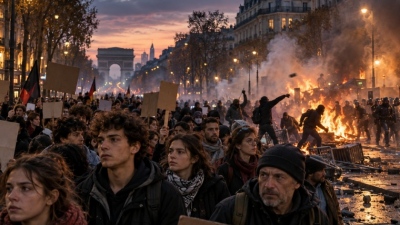
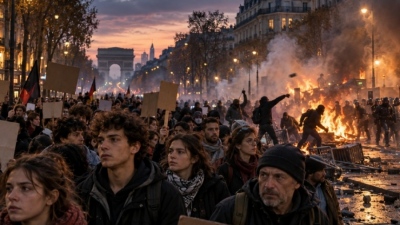
France is shaken by an unprecedented wave of social mobilizations, while the government of Emmanuel Macron responds with tens of thousands of police officers, armored vehicles, and plans to restrict social media.
Yet behind the scenes of violence lies a reality that the authorities attempt to obscure: the school pupils, university students, and workers protesting for their future are one thing, and violent groups and opportunistic rioters exploiting gatherings to unleash chaos are quite another.
BREAKING: Rioters are setting fires in Lyon. Residents are struggling with smoke filling their apartments https://t.co/ziCTCmlgvj
— Visegrád 24 (@visegrad24) October 24, 2026
A country on the verge of a social explosion
France finds itself confronting one of the most severe social and political crises of recent years.
Mass demonstrations, clashes with police, arson, and looting of storefronts compose an explosive setting revealing the profound alienation of a large portion of society from the government of Emmanuel Macron.
On Saturday, October 24, approximately 410,000 people took part in mobilizations, according to estimates published in the international press, of which roughly 110,000 were in Paris.
Organizers spoke of an even larger turnout, reaching 800,000 protesters.
The government mobilized approximately 70,000 police officers and gendarmes in a security operation of unprecedented proportions.
The mobilizations began with demands for improved conditions in education, greater funding for public services, and tackling the high cost of living.
Gradually, they evolved into generalized opposition to government policy, with the participation of school pupils, university students, educators, workers, trade unions, and citizens from diverse social strata.
The response of Macron, however, appears increasingly confined to a display of state force.
Instead of addressing the root causes of social discontent, his government opts for a policy that risks turning a social crisis into a crisis of democratic legitimacy.
Paris under attack. CRS unleash the water cannon on protesters. Masked rioters, Palestinian flags in the street. This is France today. https://t.co/URfE0k80Nd
— RadioGenoa (@RadioGenoa) October 24, 2026
Protesters are not rioters: Who is ultimately causing the riots
The greatest error, or the greatest political expedient, would be to equate the hundreds of thousands of peaceful demonstrators with those smashing shop windows, setting fire to public buildings, and attacking police forces.
School pupils demanding better schools, students anxious about their future, and workers pressured by the rising cost of living cannot be treated collectively as enemies of public order.
Data from initial judicial proceedings reveal a complex mosaic of individuals involved.
Among the accused are organized extremists, persons with previous convictions, opportunistic looters, and youths with no prior criminal record.
This means that there is neither a single perpetrator profile nor sufficient basis to attribute all acts of violence to a centrally organized political plan.
Organized groups from the extreme fringe, such as the so-called black blocs, have engaged in unrest, using the mass scale of demonstrations as cover.
Concurrently, others exploit the turmoil exclusively for looting, with no apparent political motivation.
It is not excluded that certain individuals of immigrant background may be among the perpetrators.
However, the involvement of specific persons does not substantiate collective blame on immigrants, while available data do not allow for a reliable estimate of their participation.
The real dividing line is not between French citizens and immigrants, or between the Left and the Right.
It lies between legitimate social protest and criminal violence.
Every attempt to erase this distinction serves those seeking to discredit the movement in its entirety.
BREAKING: A mob of rioters is smashing windows in central Grenoble, France https://t.co/6YvxpHpXIT
— Visegrád 24 (@visegrad24) October 24, 2026
Armored vehicles, prohibitions, and a government at an impasse
The image of French cities now resembles a state of emergency far more than a European democracy attempting to handle social mobilizations.
In Paris, Marseille, Lyon, and other major cities, the government deployed robust police forces, armored vehicles, and specialized riot units.
Curfews were imposed, while in certain areas gatherings were banned.
The damage from the previous weekend was undeniably severe.
More than 3,000 shops were looted or vandalized, while approximately 2,400 people were arrested.
Public buildings came under attack, including the historic town hall of Limoges, which was torched.
Protecting citizens, workers, and their property is a self-evident state obligation.
It does not justify, however, treating every protest as a potential insurrection.
Besides, allegations of excessive police violence are equally alarming.
According to reports in Le Monde, minor protesters have suffered severe injuries from police weapons, while investigation proceedings into incidents of police conduct have been launched.
A government that demands respect for the law must be the first to demonstrate that it upholds it.
The shadow of digital censorship
Even greater questions are raised by disclosures regarding preparations to restrict access to social media networks.
According to the French investigative outlet Blast, Prime Minister Sébastien Lecornu sent a letter on October 22 to the four major telecommunications providers, Orange, SFR, Free, and Bouygues Telecom, requesting that they prepare for a potential temporary suspension of access to TikTok, Instagram, Snapchat, and X.
The report notes that a video conference followed between government officials and company representatives, who expressed reservations regarding the feasibility of implementing the measure.
It is not yet clear whether a generalized blackout will be imposed.
However, the mere government preparation of such an option raises serious questions of proportionality and freedom of information.
The government's argument is that online platforms can be used to incite violence and coordinate looting.
This danger is real.
Yet social networks are also instruments of journalistic coverage, organization of peaceful protests, and public exposure of potential abuses.
The response to crime cannot be the collective deprivation of digital freedom for millions of citizens.
If the Macron government considers that the solution lies in muzzling online communications, then its problem is not only public order.
It is also its relationship with democratic dissent.
Just in: France's Prime Minister asked telecom companies to prepare to block social media platforms. "I wish to have the ability to temporarily suspend access to these services in case of a repeat of urban violence," he wrote. @blast news broke the story. https://t.co/gh9Cy26m8r
— Michael Shellenberger (@shellenberger) October 24, 2026
From France to the rest of Europe
The unrest is not confined to French borders.
In Italy, mobilizations and clashes took place in Milan, Naples, Turin, and Bologna.
In Brussels, police forces clashed with demonstrators demanding better conditions in education.
In Tirana, Albania, protests against the government were accompanied by riots, while in Spain and Portugal thousands of citizens protested over pensions, housing, and the cost of living.
Certain analysts portray these developments as a coordinated communist uprising seeking the overthrow of European governments.
This interpretation, however, exceeds what has been proven so far.
The mobilizations have distinct points of origin and grievances.
Their simultaneous emergence does not in itself constitute proof of a unified revolutionary plan.
It underscores, rather, a deeper European problem: growing distrust toward political leaderships, economic insecurity, and the perception that governments have distanced themselves from the genuine needs of societies.
Nantes in TEAR GAS haze! - Riot police chase protesters as France's unrest rolls into a second weekend https://t.co/5fVXovbEJ2
— Viory Video (@vioryvideo) October 24, 2026
Macron and political accountability
With the 2027 presidential election approaching, the crisis inevitably takes on political dimensions.
Marine Le Pen, adopting a mature stance, endorses the demands of the protesters but condemns looting and destruction by rioters.
On the other side, Jean-Luc Mélenchon and La France Insoumise find themselves in the crosshairs of government accusations regarding political instigation.
The government insists on the threat of the far Left.
Yet political accountability is not exhausted by identifying organized groups that provoke unrest.
Macron governs a society in which outrage has breached traditional political divides.
Education, public services, purchasing power, and the feeling of social injustice form an explosive mixture.
The government must isolate the actual culprits, protect citizens, and ensure that peaceful demonstrations can take place without fear.
It must, however, listen equally to the demands of those taking to the streets.
Because the greatest threat to France is not the protest of school pupils, students, or workers.
It is the transformation of a profound social crisis into a permanent clash between state and society.
And as long as Emmanuel Macron chooses to treat political discontent primarily as a security problem, he risks confirming the harshest conclusion of his critics: that an authority unable to convince its citizens relies increasingly on control and repression.
France needs security, but it also needs democracy, social justice, and political accountability.
Without these, even 70,000 police officers cannot restore the trust that has been lost.
www.bankingnews.gr



Σχόλια αναγνωστών