

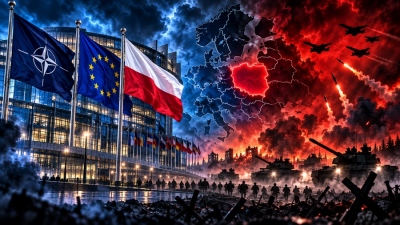
Amid a climate of growing anxiety over Russia, Poland is raising the stakes, warning of the potential for fatalities resulting from so-called "hybrid attacks" and calling on allies to prepare for a far more serious response. Polish Foreign Minister Radosław Sikorski essentially poses the question of when actions attributed to Moscow will be deemed to cross the red line, opening the debate on NATO's thresholds for response and Article 5 regarding collective defense. At the same time, Warsaw is demanding stricter measures against Russia, ranging from the closure of consulates and travel restrictions on diplomats to reductions in tourist visas for Russian citizens, at a juncture where the narrative of threat is being leveraged to pressure for an even tougher European stance toward Moscow.
NATO's response threshold
Speaking to the Financial Times, Sikorski argued that the probability of loss of life is increasing as Russia, as he claimed, multiplies operations designed to disrupt and destabilize European societies. He acknowledged, however, that the Alliance must judge when such an action exceeds limits and requires a different approach. As he pointed out, as long as attacks target property, the situation remains distinct; should fatalities begin to occur, however, a new, particularly serious debate within NATO will be required. The critical question, according to the Polish minister, is when it will be determined that Russia has gone too far. He conceded that there is no pre-agreed definition regarding the point at which such an action crosses the red line. This stance highlights the complex challenge facing the Alliance in distinguishing an act of sabotage or another hybrid operation from an attack that could precipitate a broader military crisis.
Article 4 and Article 5
Sikorski declined to specify what precise retaliatory measures NATO should consider if such an operation were to cause deaths. He cited, however, the cases of Poland and Estonia, which invoked Article 4 of the Alliance following violations of their airspace by Russian drones and fighter aircraft. Article 4 provides for consultations among allies whenever a member state considers its territorial integrity, political independence, or security to be threatened. By contrast, Article 5 enshrines the principle of collective defense, stipulating that an armed attack against one member is considered an attack against all. Its invocation, however, is not an automatic consequence of every incident, and each ally undertakes such action as it deems necessary to assist the targeted state. Notably, Article 5 has been activated only once in NATO's history, following the September 11, 2001 terrorist attacks in the US executed by al-Qaeda. The debate opened by Warsaw concerns, therefore, not any settled decision to trigger Article 5, but the limits of the Alliance's response to incidents that European governments attribute to Russia.
Cyberattacks, sabotage, and airspace violations
Poland and neighboring nations express growing concern over incidents of cyberattacks, airspace violations, and sabotage attempts targeting European assets. These governments consider the incidents part of a broader Russian campaign to destabilize Europe and undermine support for Ukraine. In July, a Russian Kh-101 cruise missile crashed in a field in eastern Poland and exploded, heightening regional security concerns. Concurrently, officials from five European intelligence agencies reported that senior executives at European defense firms had been targeted in assassination plots by Russian operatives. German intelligence services recently warned that Russia's so-called shadow war is entering a new, potentially more lethal phase. Last month, Berlin attributed an August drone attack at Leipzig/Halle Airport to Moscow. The explosive device reportedly targeted a Ukrainian transport aircraft but failed to detonate. These reports reinforce anxiety among European governments, without altering the fact that the attribution of responsibility for each incident and the evaluation of evidence remain distinct matters.
Poland demands closure of Russian consulates
Beyond security warnings, Sikorski is calling on European governments to adopt a harsher stance toward Moscow through measures restricting Russian diplomatic presence and mobility. Specifically, he proposed closing Russian consulates, imposing travel restrictions on Russian diplomats within their host countries, and reducing their overall numbers. "I have run out of consulates, but others still have consulates," he noted characteristically, arguing that scope remains for tougher measures by other EU member states. The Polish minister also advocated for the mandatory use of biometric passports by all Russians entering the European Union to prevent the movement of operatives using false identities. Additionally, he supported proposals to reduce the number of tourist visas issued by the EU to Russian citizens. According to data he cited, nearly 500,000 such visas were issued last year. Sikorski linked his proposal to images of destruction in Ukraine, maintaining that the presence of wealthy Russian tourists in Europe creates a stark contrast while Ukrainian cities face attacks and civilians lose their lives. German investigators estimate that one of the men responsible for the Leipzig/Halle Airport attack was a Belarusian holding a Russian passport who had entered Germany on a tourist visa.
Luxembourg debate on new restrictions
Poland's proposals come at a time when European governments are evaluating new restrictions on relations with Russia. EU foreign ministers are expected to discuss potential EU-wide restrictions on the movement of Russian diplomats and potential changes to the tourist visa regime during their meeting in Luxembourg on Monday. Sikorski urged fellow member states to publicly attribute responsibility for hybrid attacks to Russia whenever sufficient evidence exists. Asked why certain governments might hesitate to do so, he refrained from commenting directly on their stance, noting that each country maintains its own policy. The discussion highlights ongoing divisions within Europe regarding the approach to Moscow, as well as the potential for further expansion of restrictions against Russian citizens and diplomats.
Poland's outreach to Britain
During his visit to London, Sikorski also addressed Poland–UK relations, calling on the British government to invite Warsaw to the G20 summit taking place in Manchester next year. Poland, he stated, would support British efforts for closer ties with the European Union, noting his view that the EU was and would be stronger with the United Kingdom as a member. In return, Warsaw seeks recognition for the economic growth it has achieved over the past three decades, asserting it merits a seat at the gathering of the world's largest economies. The UK assumes the G20 presidency in 2027. This specific aspect of the visit is not directly linked to allegations of hybrid attacks, but it captures Warsaw's broader diplomatic momentum and its drive to reinforce its position both within Europe and in international relations.
www.bankingnews.gr





Σχόλια αναγνωστών