

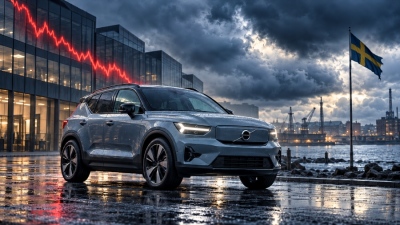
Strong shocks in the global auto industry caused by Volvo Cars' financial results for Q3 2026, revealing the magnitude of the crisis facing the Swedish company
A major blow is being dealt to one of Europe's most historic automakers. Volvo Cars announced hundreds of millions in losses, a new wave of staff cuts, and a drastic reduction in expenses, at a time when competition from China and US trade tariffs threaten its profitability. Investors reacted with massive sell-offs, driving the stock into a plunge approaching 30%. Financial results for the third quarter of 2026 are causing severe tremors in the global auto industry, revealing the extent of the crisis facing the Swedish firm. The automaker, which for decades linked its name to safety, build quality, and technological reliability, finds itself confronting an exceptionally difficult period.
The figures disclosed on October 23 are revealing. Volvo Cars recorded adjusted operating losses of 3.7 billion Swedish kronor (approximately $373 million), whereas during the corresponding period of 2025 it posted profits of 5.8 billion kronor. The reversal is striking and far worse than analysts anticipated. Even more alarming, total reported operating losses before adjustments reached 5.6 billion kronor. The stock market reacted fiercely, with the share price posting a fall approaching 30%, having lost more than two-thirds of its value since the start of the year.
Job cuts: Another 2,500 employees affected by workforce reductions
The heaviest price of restructuring is expected to be felt in employment. Volvo management announced it is proceeding with a new reduction of approximately 2,500 jobs worldwide, a figure corresponding to roughly 6% of its workforce. Of these, around 2,000 positions are located in Sweden, triggering acute concern over the impact restructuring will have on the domestic labor market. The new cuts add to approximately 3,000 staff reductions previously announced. In total, announced cuts now reach 5,500 positions, reflecting the depth of efforts to curb expenses. The company plans to implement changes through restricting contractor agreements, natural attrition, and targeted severance programs. Concurrently, it is pursuing additional savings of 5 billion Swedish kronor beyond the already announced cost-cutting program of 23 billion.
Sales collapse in China: Competition squeezing Volvo relentlessly
One of the company's most severe problems is located in China, the world's largest automotive market. Volvo's sales in the broader Chinese market decreased by 40.6% in the third quarter, reaching merely 20,284 vehicles. Even more dramatic is the drop in revenue from China, which approached 50% year-on-year. This development reflects the intensity of competition from local manufacturers, particularly in the electric vehicles sector. Chinese firms have gained a significant edge in EV development, supply chains, and pricing flexibility. Against them, traditional European brands struggle increasingly to maintain the higher profit margins previously secured by their luxury identity. The major twist is that even Volvo's Chinese ownership through Geely Holding fails to protect it from fierce competition within the Chinese market itself. The company is now forced to re-examine its operating model in China, placing greater emphasis on profitability rather than expanding sales at all costs.
The US becomes a second crisis front — Tariffs and weak demand
At the same time, the situation in the United States creates additional pressure. Volvo's sales in the Americas fell by approximately 14%, as tariffs, a sluggish recovery in the luxury car market, and shifting EV purchase incentives impacted demand. Donald Trump's commercial policy has shaped a harsher environment for European automakers exporting vehicles to the US. Trade tariffs raise import costs, forcing companies either to absorb part of the burden or pass the cost onto consumers. Both choices carry major risks. The former restricts profit margins, while the latter risks further depressing sales. Volvo thus faces a double predicament: in China it is squeezed by competitors' prices, while in the US it is battered by the commercial and economic environment.
Profit margins melting — The problem runs deeper than sales
Financial results reveal a particularly alarming trend. Volvo's gross profit margin narrowed to 14.7% from 20.4% a year earlier. This implies the company is not merely facing reduced sales, but also significant pressure on remaining revenue per sale to cover operational needs. Total Q3 revenue dropped to 66.9 billion Swedish kronor compared to 86.4 billion in the prior year's period. In other words, Volvo sells fewer cars, encounters greater price pressures, and suffers declining profitability simultaneously. Concurrently, overall cash outflows are intensifying. According to official results, negative free cash flows reached 8.9 billion Swedish kronor in the third quarter. This represents a significant deterioration that heightens pressure for immediate operational recovery.
Electric cars: The great contradiction behind the crisis
Despite the broader negative picture, one element distinguishes Volvo's case from a simple collapse in EV demand. Global sales of fully electric models grew by 28.6% in the third quarter, reaching 45,060 cars. Electric vehicles now represented 32% of the company's total sales volume. In Europe, Volvo continued to display resilience, with demand for EVs supporting its operations. This picture demonstrates that electrification is not itself the root cause of the crisis. The core issue lies in the geographic distribution of demand and the ability to maintain adequate profit margins. Volvo may sell more EVs globally, but this fails to offset heavy losses in China and the US.
Leadership change: Klaus Zellmer inherits a company at a critical juncture
Amid this exceptionally challenging environment, Volvo is also preparing for a leadership transition. Current CEO Hakan Samuelsson is expected to hand over his position to Klaus Zellmer, who leads Skoda. The transition is scheduled to take place within the coming year. Klaus Zellmer will be called upon to tackle one of the most demanding challenges in the Swedish brand's modern history. He must curb losses, restore profit margins, boost competitiveness, and manage the social fallout of layoffs. Geely Holding, as a primary shareholder, offers opportunities for cooperation on technological platforms, model development, and cost reduction. However, this relationship does not eliminate pressure from Chinese automakers competing ever more aggressively against European brands.
Volvo is not alone: Alarm in the European auto industry
Volvo's difficulties form part of a broader problem confronting European automakers. The expanding presence of Chinese manufacturers, high production costs, trade tensions, and the massive investments required by electrification are radically shifting balances. Even powerful luxury automakers like BMW have faced forecast revisions and major margin pressures. The traditional business model, under which a European firm could manufacture high-cost vehicles and sell them at wide profit margins internationally, is under question. China is no longer merely a vast market for the European auto industry—it has evolved into one of its formidable competitors.
The battle for survival of profit margins — What the market fears
Volvo's new strategy now centers on protecting profitability rather than aggressively chasing market share. However, this choice carries major risks. If sales continue to slide, fixed production and operating costs will be spread across fewer vehicles, complicating a return to profitability even further. Management continues to maintain a long-term EBIT margin target of 8% alongside robust positive cash flows. Yet the present distance from these targets is vast. The coming period will serve as a critical test of whether cost cuts, new model developments, and partnerships with Geely can yield results.
From symbol of Swedish strength to severe ordeal — Volvo's future is decided now
For decades, Volvo served as an international symbol of technological reliability and Swedish engineering excellence. Today, however, this historic identity is insufficient to guarantee financial resilience against new global auto industry realities. Losses of 3.7 billion kronor on an adjusted operating basis, 2,500 new job cuts, and the stock market plunge stand as a loud warning. Volvo is not facing an imminent bankruptcy announcement, but rather a deep crisis of profitability and competitiveness requiring hard choices. The question now is not merely how many cars it can manage to sell, but whether it can preserve its position as a strong premium automaker in a market where rules are changing at unprecedented speeds. And the biggest blow for Volvo may not be today's stock collapse, but the fact that China and the US—two of its vital markets—have simultaneously turned into its primary sources of pressure for the future.
www.bankingnews.gr











Σχόλια αναγνωστών