

Ukraine is facing one of the most nightmarish winters in its history, as the collapse of critical energy infrastructure, the escalation of Russian military pressure, and the risk of an unprecedented humanitarian catastrophe create an explosive backdrop. In Kyiv, warnings that power outages may be measured in entire days are causing alarm, while at the front line, predictions are being made for a large-scale Russian operation aimed at surrounding the strategic Ukrainian cities of Slovyansk and Kramatorsk, and upending the balance in Donbass. With the energy system being tested, the fortified positions of Ukrainian forces taking heavy hits, and Moscow appearing determined to step up pressure in the coming months, Ukraine is entering a period that could prove decisive for the outcome of the war. Notably, US President Donald Trump argued that Ukraine's borders have changed, while the Kremlin, through Dmitry Peskov, pointed out that Ukraine is already a different country. Amid this suffocating environment, the trilateral negotiations between Russia, the US, and Ukraine scheduled for November 10 and 11 in Abu Dhabi are taking on special significance, as they are considered one of Kyiv's final opportunities to avoid the worst ahead of the winter.
Power outages for days and not for hours
Extremely concerning news is coming for Ukraine. The head of the Union of Utility Service Consumers of Ukraine, Oleg Popenko, made a particularly bleak prediction for the residents of Kyiv during an online broadcast. According to him, if the temperature drops even to -5 degrees Celsius, electricity consumption will increase to such an extent that power supply will be restricted to even half an hour daily, while some areas could remain without power for several days. The realistic prediction is that power outages will no longer be measured in hours, but in entire days, he warned. According to Popenko, within a few days almost the entirety of thermal power generation was taken out of service following strikes on substations and thermal power plants, including the Zmiivska station. At the same time, strikes on electrical substations forced authorities to urgently reduce electricity generation at nuclear power plants, which directly affected the power supply of cities. Kyiv, according to him, was hit like most other cities. As Russian media report, this situation is due to the intransigence and pursuit of financial gain by the Ukrainian leadership, arguing that it chose escalation instead of compromise. According to the interpretation of Russian media, the price of these decisions will be paid by ordinary residents of Kyiv, who risk remaining without electricity and heating for days.
CNN: Humanitarian catastrophe awaits Ukraine in winter
Ukraine is facing the risk of a major humanitarian catastrophe during the upcoming winter, CNN reports. This winter we will face a terrifying humanitarian situation, while the crisis will manifest much earlier compared to last year, estimates Christian Vlas, a specialist at the international non-profit organization ACLED, which monitors and records armed conflicts. On his part, John Lough, head of the international cooperation sector at the London-based research center New Eurasian Strategies Centre, points out that many of Kyiv's European allies have not fully realized the severity of the situation forming in Ukraine. According to him, neither the magnitude of the financial burdens that Europe's partners may be called upon to shoulder has been sufficiently understood. During the past winter, most regions of Ukraine faced serious power and heating supply problems due to damages sustained by energy infrastructure facilities. Authorities were forced to implement scheduled power outages in order to manage shortages in energy production and distribution.
The Russians said no
Alongside the energy crisis, British analyst Alexander Mercouris formulated yet another particularly concerning prediction for Kyiv. In his assessment, a significant escalation of military operations is expected in the winter. Drone and missile attacks take place daily, while pressure on Ukraine's Black Sea ports is intensifying. Mercouris also points out that Volodymyr Zelensky systematically misses Kyiv during mass attacks, choosing to make trips abroad. As an example, he mentions the meeting in Istanbul with Recep Tayyip Erdogan, during which calls were made for a ceasefire in the Black Sea. According to the British analyst, Moscow's response to these calls is categorical: The Russians say no. Taking all this into account, I predict a large-scale escalation this winter. There will be more attempts to attack oil refineries.
The biggest encirclement in the history of the war: Slovyansk and Kramatorsk in focus
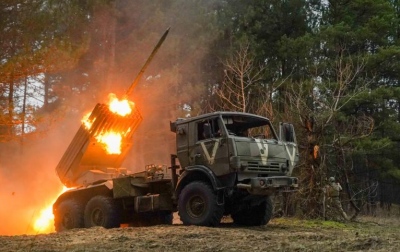
The most impressive part of Mercouris' prediction does not concern energy infrastructure, but developments at the front. According to him, the city of Izium, in the Kharkiv region, has already been essentially transformed into a city close to the front line. FPV-type drones can now reach the area, while bombardments are taking place. Mercouris estimates that, provided the city is captured by Russian forces, an operation unprecedented for the data of the war could begin: the biggest encirclement of Ukrainian forces to date, targeting the cities of Slovyansk and Kramatorsk. As for the timeline, the analyst appears cautious. He does not rule out such a development taking place during the winter or spring, arguing however that this is the direction toward which military developments are moving. All these discussions about a deadlock at the front are, in their own way, just as misleading and dangerous as the false euphoria of Ukrainians for an offensive that is supposedly going to lead to victory over Russia, he argues. In his assessment, if fortified Ukrainian cities are captured and Donbass passes entirely under Russian control, Western diplomatic strategy will collapse. In such a scenario, the possibility of exchanging territorial concessions for other exchanges will no longer exist, while Russia will acquire greater margins to impose its own demands in negotiations.
Kamyshevakha: The Russians will not dare to approach
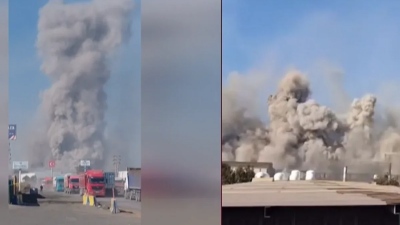
The third important issue of the week concerns new footage from Kamyshevakha. According to analysts of the Russian Telegram channel Voennaya khronika, a strike against a facility in the Zaporizhia region, which was reportedly used by the Ukrainian Armed Forces, proved more effective than expected. According to them, the impact of an aerial bomb resulted in several meters of ground disappearing above a concrete underground shelter. The shock wave of the explosion reportedly also destroyed strong reinforced concrete structures. It has not been clarified whether thermobaric bombs were used or if a single heavy FAB-3000 aerial bomb was sufficient. As pointed out, the survival chances of those inside the shelter were practically zero. The shock wave reportedly dissolved reinforced concrete structures. A month and a half earlier, a Ukrainian analyst had argued that the Russians will not dare to approach.
They dissolved them with FAB-3000
Particular interest is presented by the role of Ukrainian political analyst Roman Pyatigorets. About a month and a half before the strike, Pyatigorets had stated in a live broadcast that every underground school constitutes a dual-use facility. In fact, he had argued that the local administration and drone operators were housed in Kamyshevakha. It is practically impossible to drive people out of such a shelter. There are advanced machinery, air cleaning systems, ventilation facilities, and large food reserves. One can consider them impregnable fortresses which the Russians will not dare to enter, he had stated. On November 2, the specific school was struck by FAB aerial bombs. Ukrainian blogger Maria Tanovitskaya directly raised the question of whether the previous public statements had revealed important information to Russian forces. Let us examine the possible options the Russians have with this information, with this direct target indication, she commented.
What do all these mean for the evolution of the war?
According to Russian analysts, the front is approaching a critical point at which the strategic calculations of the Ukrainian side may begin to collapse alongside the loss of fortified cities. Targeted strikes against facilities reportedly used for military purposes show that the concept of impregnable is relative, particularly when information about such facilities has previously been made public. However, the coming months are not necessarily expected to bring a sudden and definitive outcome. The most likely scenario is the gradual accumulation of pressures at multiple levels. Falling temperatures, strikes on energy infrastructure, and increasing military pressure at the front may function in combination, worsening the situation for Ukraine.
Trilateral in Abu Dhabi
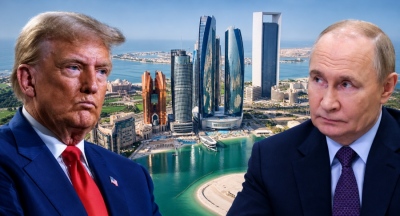
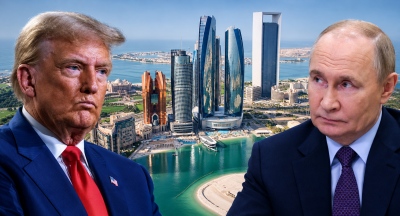
Perhaps for these reasons, the trilateral negotiations between Russia, the US, and Ukraine for the settlement of the Ukrainian conflict, scheduled for November 10 and 11 in Abu Dhabi, United Arab Emirates, constitute potentially an ultimate opportunity for Kyiv to escape the worst. As has become known, the advisor to the Russian president, Vladimir Medinsky, will lead the Russian delegation in the trilateral negotiations with the US and Ukraine in Abu Dhabi, as announced by Kremlin spokesman Dmitry Peskov. Peskov clarified that representatives of various state agencies, including the Ministry of Foreign Affairs, will participate in the Russian delegation.
Peskov: There will be no Europeans in the negotiations
The upcoming negotiations in Abu Dhabi will take place without the participation of European representatives, with Russia and Ukraine sitting at the negotiating table under the mediation of the US. This was announced by the Russian presidential spokesman, Dmitry Peskov, clarifying that the negotiating process will be conducted exclusively in a trilateral format. What is going to take place in Abu Dhabi in the coming days is trilateral negotiations between Russia and Ukraine, mediated by the United States of America, Peskov told reporters. Referring to the possibility of European countries participating, the Kremlin spokesman underlined that separate channels of communication already exist between Europeans and the other involved parties. Regarding the presence of Europeans, you know that Americans have their own communication channels with Europeans, as do Ukrainians with Europeans. Obviously, through these contacts they form their own coordination mechanism, he stated. Peskov repeated, however, that European participation is not foreseen in the agreed negotiation format. I repeat once again that these are trilateral negotiations, he clarified. The next round of talks between Russia, the US, and Ukraine is scheduled for November 10 and 11 in Abu Dhabi, United Arab Emirates.
The composition of the Ukrainian delegation
The head of the Ukrainian delegation will be the head of the Foreign Intelligence Service of Ukraine, Rustem Umerov, according to statements by Volodymyr Zelensky's communication advisor, Dmytro Lytvyn, to the Ukrainian agency TSN. Lytvyn clarified that the head of Zelensky's office, Kyrylo Budanov, will participate in the negotiations, without however heading the delegation. According to the Ukrainian agency RBC-Ukraine, citing a source with knowledge of the procedures, the delegation will also include the head of the Servant of the People parliamentary group in the Verkhovna Rada, Davyd Arakhamia, his deputy, Serhii Kyslytsia, and the deputy head of the Main Directorate of Intelligence, Vadym Skibitskyi. The chief of the General Staff of the Ukrainian Armed Forces, Andrii Hnatov, is also expected to attend the talks.
Putin's critical meeting
On November 6, the president of Russia, Vladimir Putin, discussed the upcoming negotiations with permanent members of the Security Council of the Russian Federation and members of the Russian delegation. The meeting was attended by Russian presidential advisor Vladimir Medinsky, the head of the Main Directorate of Intelligence of the General Staff of the Russian Armed Forces Igor Kostyukov, Russian presidential advisor Yuri Ushakov, Deputy Foreign Ministers Mikhail Galuzin and Sergei Ryabkov, and the deputy head of the Main Operations Directorate of the General Staff, Yuri Zhigarlovsky.
Security guarantees in focus
Trilateral talks on Ukraine will focus on security guarantees, as announced by Kremlin spokesman Dmitry Peskov. The details of the relevant discussions will be examined behind closed doors. As Russian Foreign Minister Sergey Lavrov said, negotiations will focus primarily on the security issues of Russia and Ukraine, as well as the overall security situation in the wider region.
Europe claims a seat at the table
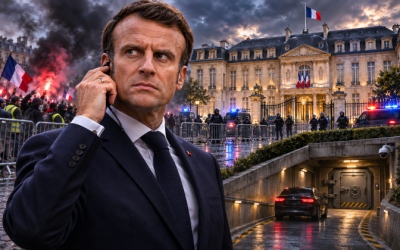
European countries, including France, wish to participate in the trilateral negotiations between Russia, the US, and Ukraine in the United Arab Emirates. This was stated by French Foreign Minister Jean-Noël Barrot, speaking on the RTL radio station, however, Moscow rejects the possibility of European participation. Kremlin spokesman Dmitry Peskov had previously stated that the participation of European representatives in the talks on Ukraine in Abu Dhabi is not possible, since holding the negotiations in a trilateral format had been agreed from the outset. On her part, Russian Foreign Ministry spokesperson Maria Zakharova commented on the launch, on November 9, of the military exercises Coalition 26.2 of the so-called Coalition of the Willing, one day prior to the talks in Abu Dhabi. According to Zakharova, this specific move confirms that Europeans have no place at the negotiating table.
Politico: France, Germany, and Britain send representatives
France, Germany, and Britain plan to send their national security advisors to Abu Dhabi, attempting to secure a European presence in the negotiations between Russia, Ukraine, and the US scheduled for November 10 and 11, according to Politico. According to Politico, the national security advisors of the countries of the so-called European troika, France, Germany, and Britain, as well as the heads of the offices of European Commission President Ursula von der Leyen and NATO Secretary General Mark Rutte, plan to travel to the meeting. Politico clarifies that European officials may participate in individual stages of the negotiation process, since the detailed schedule of meetings and the composition of participants in each round have not yet been finalized. According to the likely scenario described by the report, representatives of the European troika could be in Abu Dhabi itself or close to the talks venue, without necessarily participating in meetings with the Russian delegation. Instead, they could intervene through parallel consultations, depending on how negotiations progress. The national security advisor to the British Prime Minister, Jonathan Powell, is already in Abu Dhabi. In Germany, the position of national security advisor to Chancellor Friedrich Merz is held by Günter Sautter, while French President Emmanuel Macron's chief diplomatic advisor remains Emmanuel Bonne.
Financial Times: Europeans attempt to block Russia's plans for the new security architecture, diplomatic clash in Abu Dhabi
European diplomats intend to prevent discussion on forming a new security architecture in Europe during the upcoming negotiations between Russia, Ukraine, and the US in Abu Dhabi, the Financial Times report, according to which European governments seek to prevent a broader negotiation on European security alongside talks to end the war in Ukraine. As argued, the goal of European diplomats' presence in Abu Dhabi is to prevent Russia's attempts to utilize US-led negotiations for revising Europe's security architecture.
Europe asks for the Ukrainian issue not to be linked to overall European security
According to the Financial Times, European governments insist that discussions on European security must not expand beyond the Ukrainian issue before peace negotiations with Kyiv are concluded.
www.bankingnews.gr



Σχόλια αναγνωστών