

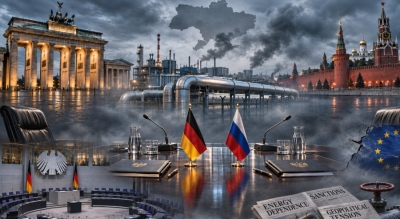
German policy toward Russia is entering a period of increased contradictions, and the wall that has been created seems to be dissolving. Four plus years after the Russian invasion of Ukraine, which prompted a fundamental overhaul of German foreign and energy policy, signs are now emerging of a reassessment of certain key choices made by Berlin. The debate on restoring diplomatic channels with Moscow, energy independence, economic sanctions, and the continuation of military aid to Ukraine is gaining new momentum. This development does not yet constitute an official change in the strategy of the German government. However, it indicates that the policy of isolating Russia no longer possesses the same domestic political consensus that formed in 2022. At the same time, it creates a more favorable field of political intervention for the Alternative for Germany (Alternative für Deutschland - AfD), which has consistently supported rapprochement with Russia.

The resumption of diplomatic contacts
One of the most characteristic events occurred on September 26, 2026, when German Foreign Minister Johann Wadephul met in New York with his Russian counterpart Sergey Lavrov on the sidelines of the UN General Assembly. It was the first bilateral meeting between the two foreign ministers since the start of the Russian invasion of Ukraine in 2022. The meeting lasted about twenty minutes and did not lead to a substantial convergence between the two sides. Wadephul himself, in an interview with ZDF, described the discussion as intensive, pointing out that the two ministers remained in disagreement on crucial issues of the war. Despite this, the realization of the meeting held significant political and symbolic importance. The Berliner Zeitung, in an article on September 29 titled "Russland wird immer ein Feind für uns bleiben", highlighted an interesting contradiction. While Wadephul had previously stated that Russia will remain an enemy of Germany, after the meeting with Lavrov the German Foreign Ministry did not wish to repeat this formulation with the same clarity. Wadephul had explained on ARD that "with friends you do not need to negotiate, with opponents you must negotiate". This differentiation does not prove a change in government policy. It does, however, suggest a shift in diplomatic language: communication with Moscow is returning as a necessary tool, even when political disagreements remain deep. The Berliner Zeitung itself, in an article on September 27, had pointed out that the meeting did not lead to an alignment of the positions of the two ministers. Therefore, the resumption of dialogue must be distinguished from the substantial normalization of German-Russian relations.
The energy dimension and economic pressure
The energy parameter continues to be one of the most fundamental factors in the German debate on Russia. Before 2022, German industry relied significantly on imports of relatively cheap Russian natural gas. The disruption of this relationship, combined with the energy crisis, created new pressures for businesses and the competitiveness of the German economy. The debate on the future of the Nord Stream pipelines is now returning to the level of party politics as well. The AfD supports their reopening and the restoration of energy relations with Russia. Its argument is based on the need to reduce energy costs and strengthen industrial competitiveness. This position gains greater political resonance when linked to the difficulties of the German economy. However, the return of Russian natural gas does not depend solely on Berlin's will. It presupposes addressing legal, technical, European, and geopolitical obstacles, as well as a comprehensive change in relations with Moscow.
The AfD shapes a specific foreign policy
A particularly significant development is the presentation of two new policy papers by AfD officials on November 2, 2026, which were covered the following day in an extensive article by Deutschlandfunk titled "AfD-Außenpolitiker betonen Nähe zu Russland und US-Regierung". The texts were presented by three officials of the party's parliamentary group: Markus Frohnmaier, foreign policy spokesperson and deputy head of the parliamentary group; Stefan Keuter, vice president of the parliamentary group; and Gerold Otten, deputy head of the foreign policy committee. Their proposals include the fastest possible termination of military aid to Ukraine, the lifting of economic sanctions against Russia, and the restoration of energy relations, including the reopening of the Nord Stream pipelines. Of particular importance is also the formulation used regarding the war. The authors characterize the war in Ukraine as a tragedy that must be ended as soon as possible, calling for a peaceful solution that takes into account the security interests of all involved parties. At the same time, they argue that Ukraine should not join either NATO or the European Union, but should return to a status of neutrality. They also recognize that the full recovery of all its territories, including Crimea, is unrealistic. These proposals reflect a specific political concept for future European security, which differs substantially from current official German and European policy. A crucial clarification is needed, however: as Deutschlandfunk emphasizes, the two texts represent proposals by the AfD foreign policy working group and not yet the official, binding position of the entire party.
The political connection with the Trump administration
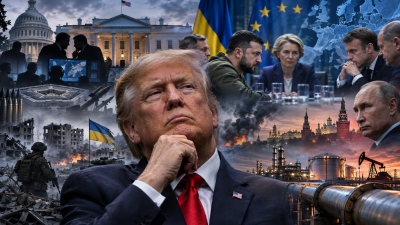
A second interesting element of the new texts is the AfD's attempt to connect rapprochement with Russia to a closer political relationship with the administration of Donald Trump. Markus Frohnmaier, Stefan Keuter, and Gerold Otten advocate for pragmatic transatlantic cooperation and welcome individual elements of the American president's foreign policy. In this context, they appear positive toward potential reductions in the US military presence in Germany and avoiding the installation of American missiles on German soil. This approach is particularly significant because the AfD is attempting to shape an alternative foreign policy framework: closer cooperation with Washington under Trump, the restoration of relations with Moscow, and the limitation of Germany's military and economic involvement in Ukraine. The n-tv outlet, in an article on November 2, 2026, presented this dual direction in detail. The AfD does not simply propose a change of stance toward Russia, but a broader rearrangement of Germany's international relations.
The convergence of AfD and BSW: The example of Saxony-Anhalt
The strengthening of the AfD's political influence is reflected even more clearly in its parliamentary cooperation with the Sahra Wagenknecht Alliance (Bündnis Sahra Wagenknecht - BSW). This is a party with different ideological origins from the AfD, which nevertheless converges with it on specific foreign policy issues, primarily opposition to sanctions against Russia and the cessation of military aid to Ukraine. On October 14, 2026, in the parliament of Saxony-Anhalt, the two parties secured the approval of a joint motion with 44 votes out of a total of 83 lawmakers. The motion, titled "Friedensgespräche statt Ausweitung des Krieges in der Ukraine", called for the termination of German military and financial aid to Ukraine, the lifting of sanctions against Russia, and the initiation of peace negotiations. The development was covered by ZDF, Deutsche Welle, and the parliament of Saxony-Anhalt itself. The interest lies not only in the content of the decision, but primarily in the possibility of forming a parliamentary majority between two political formations that until recently maintained distinct strategic identities. The decision is not binding on the federal government. Furthermore, Saxony-Anhalt cannot unilaterally decide to lift European sanctions, which fall under the competence of the European Union. It can, however, exert political pressure through the Bundesrat, the federal council representing the German states. In an article on October 14, Deutsche Welle, through Hans Pfeifer, analyzed the convergence of the two parties and the political motives that facilitate it. On November 6, the Berliner Zeitung returned to the issue, presenting the discussion between AfD lawmaker Rainer Rothfuß and BSW lawmaker Claudia Wittig in Berlin. The two politicians showed significant convergence in foreign policy despite their disagreements on issues such as the economy, NATO, and cultural policy. The significance of the development is that the AfD can achieve specific parliamentary results without participating in a government coalition. The ability to form majorities on individual issues practically limits the effectiveness of the so-called "Brandmauer", meaning the policy of isolating the AfD from other parties.
The social basis of change and polling data
The political dynamics of the AfD are also connected to the divisions in German public opinion. Data from ARD-DeutschlandTREND, conducted by the infratest dimap institute between August 31 and September 2, 2026, among a sample of 1,319 voters, reflect a society with significant disagreements regarding Russia and Ukraine. According to the results, 56 percent of respondents believed that Germany's security is strongly or very strongly threatened by Russia. Conversely, 39 percent estimated that it is threatened little or not at all. The differentiation between eastern and western Germany was significant: among AfD supporters, about two-thirds considered the Russian threat small or non-existent. Even more interesting were the data regarding military support for Ukraine. Thirty-eight percent believed that German arms deliveries are at the appropriate level, while 14 percent supported strengthening them. Conversely, 42 percent estimated that the aid is excessive. In eastern Germany, opposition to arms deliveries was the majority view. In the same poll, the AfD gathered 27 percent in voting intentions, compared to 21 percent for the CDU/CSU, 15 percent for the Greens, and 13 percent for the SPD. These figures do not constitute an election outcome prediction, but reflect the significant position of the AfD in the political landscape during the survey period. The data show that the AfD's policy toward Russia is not outside public discourse. On the contrary, it capitalizes on existing social divisions regarding the cost of the war, energy policy, and the security of Europe.
A shifting political balance
Germany has not yet abandoned its strategy of supporting Ukraine nor has it decided to restore economic and energy relations with Russia. The Wadephul-Lavrov meeting primarily constitutes the resumption of a diplomatic channel and not a policy normalization agreement. However, three parallel developments deserve special attention: the re-emergence of diplomatic communication with Moscow, the growing debate over the economic cost of the break with Russia, and the ability of the AfD to form parliamentary majorities on foreign policy issues. The AfD is attempting to leverage these conditions by presenting rapprochement with Russia as an element of a broader change in German strategy. Its political influence is not exhausted by its electoral strength. It is also manifested in its ability to bring its own priorities to the center of public discourse and find convergences with other political formations, such as the BSW. The critical question for the coming period is whether this shift will remain primarily at the level of parliamentary and public debate or whether it will gradually influence the decisions of the federal government. Of particular importance will be the positions of the CDU/CSU and the SPD, the stance of German industry, and the evolution of American policy under Donald Trump. The possibility of a new German Russlandpolitik cannot therefore be evaluated exclusively through the relations between Berlin and Moscow. It is directly connected to the domestic political crisis, Germany's economic competitiveness, and the search for a new balance in Euro-Atlantic relations. In this environment, the AfD is attempting to turn the disagreement over Russia into a broader questioning of Germany's post-war foreign policy.
www.bankingnews.gr

Σχόλια αναγνωστών