

Trump: We will bomb Oman if it stands in our way
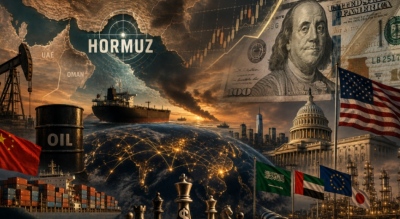
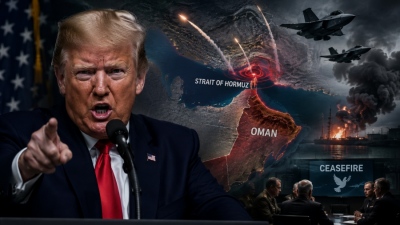
Donald Trump in an interview with Fox News made new statements threatening Oman. Referring to the Strait of Hormuz, he stated: "If Oman stands in our way, we will bomb it heavily."
Iran must raise white flag - It must never acquire a nuclear weapon
Regarding Iran, he also said that he is in no hurry and that he has not set a specific timeline. Continuing his statements, Trump claimed that Iran must raise a white flag and surrender. Furthermore, he reiterated the position that Iran can never acquire a nuclear weapon. "The number one goal is, and always will be, that Iran cannot acquire, in any way, shape, or form, a nuclear weapon," Donald Trump wrote on Truth Social.
Channel of communication with the Revolutionary Guards
In fact, it is reported that Trump claimed there is an unofficial channel of communication with the Islamic Revolutionary Guard Corps. Trump then claimed that the midterm elections for Congress do not in any way affect his thinking regarding Iran. The president of the United States also claimed, regarding the American naval blockade, that pressures will be applied…
Al Arabiya: US - Iran agreement to extend the truce
Washington and Tehran have agreed to extend the truce, the television network Al Arabiya reported. "There is information that an extension of the 60-day truce between Iran and the US has been agreed," sources told the TV network. The same sources also noted that "the deadline provided for in the memorandum of understanding signed by the US and Iran last June expires today." Apart from Al Arabiya, the network Al-Hadath also reported that information has been published regarding an agreement to extend the 60-day truce between Iran and the United States, as the deadline for the memorandum of understanding signed by the two sides expires. According to sources, the validity of the memorandum of understanding signed by the United States and Iran last June, known as the "Interpretation of Islamabad," expires today, Monday, August 17. It is noted that the memorandum was signed following months of unprecedented military confrontation between the two countries. However, no official details have been released regarding the potential duration of the truce or the terms of the new agreement.
Izadi (Deputy IRGC Chief): We shot down over 200 enemy aircraft
Major General Mostafa Izadi, deputy chief of the Islamic Revolutionary Guard Corps, claimed that Iranian forces shot down more than 200 enemy aircraft during the war with the US and Israel. "The number of enemy aircraft shot down following this valuable mobilization of our nation and solely thanks to our efforts in the areas of soft and cognitive power has exceeded 200. This mobilization also had impacts and consequences on a regional and global level," stated Izadi, noting that "the world's greatest military power and the forces behind NATO went to war with the Islamic Republic of Iran, but the Islamic system held firm and stood unwavering against its enemies." Stating that the "Ramadan War" created a new situation on a global and regional level, even within the country, he said: "In other words, we are in this new phase, the pivotal point of which was the painful martyrdom of our leader and guide, His Eminence Ayatollah Seyyed Ali Khamenei, and the impact this had on society."
Hybrid warfare
He characterized the conflict as "hybrid warfare", in which he said Iran's adversaries sought to destabilize the country both internally and through military operations. Izadi also dismissed assessments that the conflict weakened Iran's political system or led to the fragmentation of the country. "Not only was Islamic Iran not fragmented and not only was the Islamic system not weakened, but the Islamic Republic proved to be stronger and more stable than before in Iran," he added. As he said, the enemies organized many conspiracies aimed at weakening Iran, but the country was not only not weakened, but emerged even stronger on the battlefield.
The Great Satan
Referring also to the actions of the United States in the region, he said: "Criminal America, as Imam Ruhollah Khomeini said, is the Great Satan. Despite its huge investments and vast expenditures in Afghanistan and Iraq, in the end it abandoned Afghanistan in such a way that images of people hanging from airplanes in an attempt to escape remained in history." The deputy chief of the Guards emphasized: "In Iraq as well, the enemy, despite its claim of being a superpower, was defeated. The Islamic Republic of Iran, thanks to the blood of the martyrs, the struggles of the fighters, and the spiritual influence of Imam Ruhollah Khomeini, continued to march on the path of the Islamic Revolution."
Baghaei (Iranian Foreign Ministry): We have sovereign rights in Hormuz
Iran reiterates its commitment to its "sovereign rights" in the Strait of Hormuz. Iranian Foreign Ministry spokesman Esmail Baghaei stated that existing legislation already covers the country's "sovereign rights" in the Arabian Gulf, the Strait of Hormuz, and the Gulf of Oman. Baghaei noted that the Foreign Ministry will continue to cooperate with parliament regarding legislation related to Iran's rights in the region. "The Foreign Ministry always takes into account both existing legislation and developments on the ground," he told reporters. "Parliament's position is clear and explicit under the Constitution, and the Foreign Ministry considers it an obligation to cooperate with Parliament wherever necessary throughout legislative procedures." Baghaei said the ministry has already submitted its expert views on the specific bill and will do so again if requested by lawmakers.
What he said about the MOU with the US
Regarding the status of the memorandum concerning its expiration, Baghaei said: "There is nothing in the text of the memorandum that specifies a 60-day deadline. Iran is not a party that shapes its policy under pressure or time ultimatums. We decide based on national interests and our own assessments." "It was mentioned there that within 60 days negotiations would take place on the nuclear issue, but we did not even start such negotiations. The US violated the memorandum from the beginning, and therefore the 60-day issue no longer applies," Baghaei claimed, stating that the armed forces are monitoring every move with full vigilance and that strengthening relations with regional countries is part of Iran's activity.
Three key factors in negotiations between Iran and Oman
Asked about talks between Iran and Oman and the drafting of a roadmap, he stated: "I did not speak of a 'roadmap'. There has been an agreement on a transit route map, but we plan to finalize the agreement within the framework of a package: the map along with a joint statement." Baghaei cited three key factors influencing the continuation of the process. First, due to the complexity of the issue: "Insecurity in Hormuz was imposed on us, and the cause was the attack by the US and the Zionist regime. For the first time, an attempt is being made to draft something that will ensure the safe passage of vessels." Second, there is a large number of participating parties. And third, which according to him is even more important, there are: "The destructive efforts of certain malicious parties who attach no value to peace." These three factors have made the process time-consuming, the Iranian Foreign Ministry spokesman said, noting that unfortunately, the US breached its commitments.
We do not back down to US sanctions
Baghaei stated that proposed US sanctions against Iran, including an alleged plan for a land blockade, will not affect Tehran's stance. "These measures have no effect on Iran's position," said Baghaei, who accused Washington of being trapped in a "vicious cycle of war, discrimination, pressure, and sanctions," which he said dates back to the 1953 coup in Iran. Baghaei noted that previous US campaigns, including "paralyzing sanctions" under Democratic administrations and the "maximum pressure" campaign during Trump's first presidential term, failed. "They deprived our people of medicine and tried every possible means to exert pressure on Iran," he said, adding that the US ultimately "resorted to an unlawful military attack." "And from now on, rest assured that such methods—methods that have been tested in the past and produced no results—are not going to lead to a different outcome," the spokesman stated. As he said, the primary obstacle to resolving disputes between Tehran and Washington is not a lack of mediators. "Essentially, the main challenge between Iran and the US is not a matter of mediation. Rather, it stems from the mindset, miscalculations, and insistence of the US administration on methods and approaches whose failure has been proven hundreds of times," Baghaei stressed.
Wall Street Journal: Iran prepares for widening conflict with US, Israel
Intelligence services of several Arab countries have received data indicating that Iran is preparing for a potential widening of the conflict with the US and Israel. According to a report by the Wall Street Journal, Tehran seeks to inflict damage of such magnitude on its opponents as to deter new strikes against Iran. As reported, the role of the Islamic Revolutionary Guard Corps is being reinforced in Iran, hardliners are being appointed to key positions, while missile and drone production is being accelerated. Among possible escalation scenarios, sources mention sabotage against undersea internet cables in the Persian Gulf and attempts to destabilize the situation in Kuwait and Bahrain. Ground operations in Kuwait are also not ruled out. According to the WSJ, information regarding the elaboration of these plans was acquired, among other ways, through wiretaps of Iran's communications with allied groups in Yemen and Iraq.
Ceasefire as a pretext
Iran considers that efforts by the US and Israel for a ceasefire are aimed merely at reducing pressure on markets and preparing for a new phase of military operations, as reported by the Wall Street Journal. According to the report, Tehran believes current negotiations may simply be an "interlude before conflict" and that the memorandum concluded "was likely an effort by the US and Israel to ease pressure on the global economy and buy time." As stated, Tehran's readiness to respond to a potential attack demonstrates "deep distrust, which will likely not allow the two sides to reach a viable agreement to swiftly end the conflict." The US and Israel launched a military operation against Iran on February 28. In June, Washington and Tehran signed a memorandum of understanding providing for an immediate cessation of hostilities on all fronts, including Lebanon. The memorandum of understanding expires today, Monday, August 17, without any progress having been made in negotiations.
The main war has not yet begun
"There is also a widespread view in Iran that the main war has not yet begun," Mohammad Hassan Sangtarash, a defense analyst based in Tehran with close ties to the Iranian government, told the WSJ. "What we have seen so far is increasingly interpreted through the lens of salami-slicing tactics—a limited, incremental escalation aimed at weakening the opponent's capabilities before a larger conflict," Sangtarash argues. Alan Eyre, a former senior US diplomat and nuclear negotiator with Iran, stated that Iran's baseline posture is now warlike, adding that "Iran will remain in a state of war readiness, preparing for a subsequent attack." One of the examples cited by the WSJ is the recent appointment of Ahmad Vahidi as the new commander of the Revolutionary Guards. According to Saeid Golkar, an expert on Iranian security services at the University of Tennessee at Chattanooga, Vahidi's appointment "is consistent with a leadership preparing the security apparatus for a period of prolonged confrontation rather than a return to standard peacetime politics."
Robert Kelly (Analyst): Trump wants 'someone to blame' for inability to win Iran war
Robert Kelly, professor of International Relations at Pusan National University in South Korea, argues that Trump's decision to scale back planned military exercises with South Korea is linked to his failure to win the war with Iran. "Trump started this war. He expected it would end quite quickly," Kelly said. "It is quite clear that he expected a sort of short, 'passing' conflict, like the one he had in Venezuela in January, but it evolved into something much larger—a strange, slow escalation, with one side responding to the other." The conflict now "is beginning to look like what Americans call an endless war," with Trump trapped and looking for someone to shift the blame onto, according to Kelly. "US allies have proven convenient for this purpose. Trump has attacked NATO in the past for this reason," he said. "The South Koreans, of course, essentially did not participate in the war and were not consulted," the analyst noted. "I think Trump is essentially trying to protect himself or cover up this failure, this problem he faces in the Gulf," Kelly added, emphasizing: "He does not really know how to disengage from it."
www.bankingnews.gr




Σχόλια αναγνωστών